
Lincoln Aviator 2020-2026 Service Manual / Chassis / Suspension / Front Suspension - AWD / Removal and Installation - Wheel Studs
Lincoln Aviator: Front Suspension - AWD / Removal and Installation - Wheel Studs
Special Tool(s) / General Equipment
| Hydraulic Press |
Removal
NOTICE: Suspension fasteners are critical parts that affect the performance of vital components and systems. Failure of these fasteners may result in major service expense. Use the same or equivalent parts if replacement is necessary. Do not use a replacement part of lesser quality or substitute design. Tighten fasteners as specified.
-
Remove the wheel bearing and wheel hub.
Refer to: Front Wheel Bearing and Wheel Hub (204-01A Front Suspension - RWD, Removal and Installation).
Refer to: Front Wheel Bearing and Wheel Hub (204-01B Front Suspension - AWD, Removal and Installation).
-
Press the wheel stud from the wheel bearing and wheel hub.
Use the General Equipment: Hydraulic Press
.jpg) |
-
Inspect the wheel bearing and wheel hub for damage. Replace as necessary.
.jpg) |
Installation
-
Press the wheel stud into the wheel bearing and wheel hub.
Use the General Equipment: Hydraulic Press
.jpg) |
-
Install the wheel bearing and wheel hub.
Refer to: Front Wheel Bearing and Wheel Hub (204-01A Front Suspension - RWD, Removal and Installation).
Refer to: Front Wheel Bearing and Wheel Hub (204-01B Front Suspension - AWD, Removal and Installation).

 Disassembly and Assembly - Shock Absorber and Spring Assembly
Special Tool(s) /
General Equipment
Spring Compressor
Vise
DISASSEMBLY
NOTICE:
Suspension fasteners are critical parts that affect the
performance of vital components and systems...
Other information:
Lincoln Aviator 2020-2026 Owners Manual: Principle of Operation
WARNING: Vehicle modifications involving braking system, aftermarket roof racks, suspension, steering system, tire construction and wheel and tire size may change the handling characteristics of your vehicle and may adversely affect the performance of the electronic stability control system...
Lincoln Aviator 2020-2026 Owners Manual: Luggage Covers (If Equipped)
WARNING: Make sure that the posts are properly latched in mounting features. The cover may cause injury in a sudden stop or accident if it is not securely installed. WARNING: Do not place any objects on the cargo area shade. They may obstruct your vision or strike occupants of your vehicle in a sudden stop or crash...
Categories
- Manuals Home
- Lincoln Aviator Owners Manual
- Lincoln Aviator Service Manual
- Description and Operation - Jacking and Lifting
- Opening and Closing the Hood
- Anti-Theft Alarm
- New on site
- Most important about car
Fastening the Seatbelts
The front outboard and rear safety restraints in the vehicle are combination lap and shoulder belts.
Insert the belt tongue into the proper buckle (the buckle closest to the direction the tongue is coming from) until you hear a snap and feel it latch. Make sure that you securely fasten the tongue in the buckle.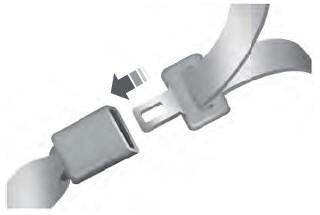

Copyright © 2026 www.liaviator2.com