
Lincoln Aviator: Body Repairs - General Information / Description and Operation - Complete Panel Replacement/Partial Replacement
Partial Replacement
.jpg)
| Item | Description |
| 1 | Sectioning area |
| 2 | Manufacture weld joint |
Decision Criteria
The following points a crucial to the decision of complete or partial replacement of the part(s).
- Is the repair economically feasible.
- Retention/integrity of the original joint.
In
addition, sectioning or partial panel replacement must meet
standardized guidelines or approved procedures in the model specific
workshop manual for a sectional replacement solution in the damaged
area.
For additional information, refer to: Body Panel Sectioning (501-26 Body Repairs - Vehicle Specific Information and Tolerance Checks, General Procedures).
Depending on the damaged area, the following points need to be considered when determining whether to perform a partial repair or complete replacement:
- Sectioning cuts should be as short as possible.
-
Feature lines and panel margins must meet original manufacture design.
For additional information, refer to: Body and Frame (501-26 Body Repairs - Vehicle Specific Information and Tolerance Checks, Description and Operation).
.
- Inner reinforcement panels must not limit the straightening work.
- Inner reinforcement profiles in the pillar areas must allow for separation.
- Partial replacements on structural frame sections must be allowed for the specific vehicle being repaired. If no procedure exists, it must be assumed no sectioning is allowed.
- The large surface welding seams at the connections must be restored.
Advantages of Partial Replacement
A partial replacement repair offers many advantages for a professional repair of accident damage:
- Repairs can be made both in the outer panel area (e.g. side frame) and in the inner areas (e.g. structural member, trunk floor).
- The repair can be limited to the actual damaged area.
- Reduction of repair costs, as aggregates and other components can usually remain in the vehicle.
Complete Replacement
In a complete replacement, the original connections are largely reused.
.jpg)
A complete replacement is advantageous if the damaged body part can be detached from its original connections and the replacement part can be fitted without creating additional joints.
A complete replacement is necessary if there is no sectional replacement solution.
 Specifications
General Specifications
Item
Specification
Plug Weld hole
8 mm (0.315 in)
Weld Wire ER70S-3
0...
 Description and Operation - Impact of Insufficient Repair Quality
Body
repairs usually require a significant level of intervention in the
existing body shell structure. The corrosion protection, seals and NVH components are destroyed and must be replaced...
Other information:
Lincoln Aviator 2020-2026 Service Manual: Description and Operation - Battery and Battery Charging Health and Safety Precautions
WARNING: Batteries contain sulfuric acid and produce explosive gases. Work in a well-ventilated area. Do not allow the battery to come in contact with flames, sparks or burning substances. Avoid contact with skin, eyes or clothing. Shield eyes when working near the battery to protect against possible splashing of acid solution...
Lincoln Aviator 2020-2026 Service Manual: General Procedures - Transmission Line Pressure Test
Materials Name Specification Motorcraft® MERCON® ULV Automatic Transmission FluidXT-12-QULV WSS-M2C949-A, MERCON® ULV Check With the vehicle in NEUTRAL, position it on a hoist. Refer to: Jacking and Lifting (100-02 Jacking and Lifting, Description and Operation)...
Categories
- Manuals Home
- Lincoln Aviator Owners Manual
- Lincoln Aviator Service Manual
- Locking and Unlocking
- General Procedures - Transmission Fluid Drain and Refill
- Body and Paint
- New on site
- Most important about car
Child Safety Locks
When the child safety locks are set, you cannot open the rear doors from the inside.
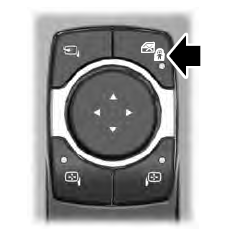
The child safety lock control is on the driver door.
Press the control to switch the child safety locks on. Press the control again to switch them off. A light on the child safety control illuminates when you switch them on.
