Lincoln Aviator: Third Row Seats / Description and Operation - Third Row Seats - System Operation and Component Description
System Operation
System Diagram
.jpg)
.jpg)
| Item | Description |
|---|---|
| 1 | SCMJ |
| 2 | HS-CAN1 |
| 3 | PCM |
| 4 | Liftgate Ajar Switch |
| 5 | Power Fold Seat Control Switch |
| 6 | Power Folding Seat Motors |
| 7 | Hall-Effect Sensors |
| 8 | Motors |
| 9 | MS-CAN |
| 10 | GWM |
| 11 | BCM |
Network Message Chart
SCMJ Network Input Messages
| Broadcast Message | Originating Module | Message Purpose |
|---|---|---|
| Vehicle speed | PCM | The vehicle speed is one of the inputs the SCMJ requires to enable the power folding seat feature. |
| Liftgate ajar switch | BCM | Provides the status of the rear lifgate. The rear liftgate position is one of the inputs the SCMJ requrires to enable the power folding seat feature. |
Power-Folding Seats
The third row power seat system includes the following components:
- Power fold seat control switch (located on the RH loadspace trim panel)
- SCMJ (located under the LH 2nd row seat cushion)
- LH and RH power-fold seat motors (part of the third row seat backrest)
The power fold motors rotate the LH or RH seat backrests. The motor assemblies contain Hall-effect sensors that indicate backrest position to the SCMJ.
The LH and RH latch motors receive voltage from the SCMJ.
The third row power fold seat only operates when the vehicle is stationary and the liftgate is open. The folding head restraints must be manually returned to the upright position. Power to the seat times out after 10 minutes but can be enabled by opening any door, turning the ignition on, pressing any keyless entry keypad button (if equipped) or the unlock button on the remote transmitter.
Component Description
Power Fold Seat Motor
The power fold seat motors are bi-directional and each contains a Hall-effect sensor used by the SCMJ to monitor motor movement and seat position. The power fold seat motors are serviced by installing a new third row seat backrest.
SCMJ
The SCMJ controls the operation of the third row power fold seat. PMI is required when a new SCMJ is installed.
Power Fold Seat Control Switch
The power fold seat control switch is an input to the SCMJ. The power fold seat control switch contains 3 momentary contact switches:
- LH seat
- RH seat
- Both LH and RH seats
Resistors within the power fold seat switch allow the SCMJ to determine the direction each switch is activated.
 Description and Operation - Third Row Seats - Overview
Overview
Third Row Power Fold Seats
Pressing and releasing the power fold seat control switch (located in the rear cargo area on the RH loadspace trim panel) causes the corresponding third row seat backrest(s) to fold forward for additional cargo space...
 Diagnosis and Testing - Third Row Seats
Diagnostic Trouble Code (DTC) Chart
Diagnostics in this manual assume a certain skill level and knowledge of Ford-specific diagnostic practices. REFER to: Diagnostic Methods (100-00 General Information, Description and Operation)...
Other information:
Lincoln Aviator 2020-2026 Service Manual: General Procedures - Fuel Tank Draining
Special Tool(s) / General Equipment 292-00004Fuel Tanker 100 GPM Draining WARNING: Before beginning any service procedure in this section, refer to Safety Warnings in section 100-00 General Information. Failure to follow this instruction may result in serious personal injury...
Lincoln Aviator 2020-2026 Service Manual: Diagnosis and Testing - Intake Air Pressure and Temperature
Diagnostic Trouble Code (DTC) Chart Diagnostics in this manual assume a certain skill level and knowledge of Ford-specific diagnostic practices.REFER to: Diagnostic Methods (100-00 General Information, Description and Operation). Diagnostic Trouble Code Chart Module DTC Description Action PCM P007A:00 Charge Air Cooler Temperature Sensor Circuit (Bank 1): No Sub Type Information GO to Pinpoint Test DN PCM P007B:00 Charge Air Cooler Temperature Sensor Circuit Range/Performance (Bank 1): No Sub Type Information GO to Pinpoint Test DN PCM P007C:00 Charge Air Cooler Temperature Sensor Circuit Low (Bank 1) : No Sub Type Information GO to Pinpoint Test DN PCM P007D:00 Charge Air Cooler Temperature Sensor Circuit High (Bank 1) : No Sub Type Information GO to Pinpoint Test DN PCM P0096:00 Intake Air Temperature Sensor 2 Circuit Range/Performance (Bank 1): No Sub Type Information GO to Pinpoint Test DN PCM P0097:00 Intake Air Temperature Sensor 2 Circuit Low (Bank 1): No Sub Type Information GO to Pinpoint Test DN PCM P0098:00 Intake Air Temperature Sensor 2 Circuit High (Bank 1): No Sub Type Information GO to Pinpoint Test DN PCM P00CE:00 Intake Air Temperature Measurement System - Multiple Sensor Correlation (Bank 1): No Sub Type Information GO to Pinpoint Test DN PCM P0106:00 Manifold Absolute Pressure/Barometric Pressure Sensor Circuit Range/Performance: No Sub Type Information GO to Pinpoint Test DM PCM P0107:00 Manifold Absolute Pressure/Barometric Pressure Sensor Circuit Low : No Sub Type Information GO to Pinpoint Test DM PCM P0108:00 Manifold Absolute Pressure/Barometric Pressure Sensor Circuit High: No Sub Type Information GO to Pinpoint Test DM PCM P0109:00 Manifold Absolute Pressure/Barometric Pressure Sensor Circuit Intermittent: No Sub Type Information GO to Pinpoint Test DM PCM P012B:00 Turbocharger/Supercharger Inlet Pressure Sensor A Circuit Range/Performance: No Sub Type Information GO to Pinpoint Test DM PCM P012C:00 Turbocharger/Supercharger Inlet Pressure A Sensor Circuit Low: No Sub Type Information GO to Pinpoint Test DM PCM P012D:00 Turbocharger/Supercharger Inlet Pressure Sensor A Circuit High: No Sub Type Information GO to Pinpoint Test DM PCM P012E:00 Turbocharger/Supercharger Inlet Pressure Sensor A Circuit Intermittent/Erratic: No Sub Type Information GO to Pinpoint Test DM PCM P0235:00 Turbocharger/Supercharger Boost Sensor A Circuit: No Sub Type Information GO to Pinpoint Test DM PCM P0236:00 Turbocharger/Supercharger Boost Sensor A Circuit Range/Performance: No Sub Type Information GO to Pinpoint Test DM PCM P0237:00 Turbocharger/Supercharger Boost Sensor A Circuit Low: No Sub Type Information GO to Pinpoint Test DM PCM P0238:00 Turbocharger/Supercharger Boost Sensor A Circuit High: No Sub Type Information GO to Pinpoint Test DM PCM P025E:00 Turbocharger/Supercharger Boost Sensor A Intermittent/Erratic: No Sub Type Information GO to Pinpoint Test DM PCM P1104:00 Internal Control Module MAP Sensor Performance : No Sub Type Information GO to Pinpoint Test DM PCM P2227:00 Barometric Pressure Sensor A Circuit Range/Performance: No Sub Type Information GO to Pinpoint Test DO PCM P2228:00 Barometric Pressure Sensor A Circuit Low: No Sub Type Information GO to Pinpoint Test DO PCM P2229:00 Barometric Pressure Sensor A Circuit High: No Sub Type Information GO to Pinpoint Test DO PCM P2230:00 Barometric Pressure Sensor A Circuit Intermittent/Erratic: No Sub Type Information GO to Pinpoint Test DO PCM U060B:00 Lost Communication With Turbocharger/Supercharger Boost Sensor A: No Sub Type Information GO to Pinpoint Test DM PCM U066D:00 Lost Communication With Charge Air Cooler Temperature Sensor Bank 1: No Sub Type Information GO to Pinpoint Test DN Global Customer Symptom Code (GCSC) Chart Diagnostics in this manual assume a certain skill level and knowledge of Ford-specific diagnostic practices...
Categories
- Manuals Home
- Lincoln Aviator Owners Manual
- Lincoln Aviator Service Manual
- Opening and Closing the Hood
- Description and Operation - Jacking and Lifting
- General Procedures - Transmission Fluid Drain and Refill
- New on site
- Most important about car
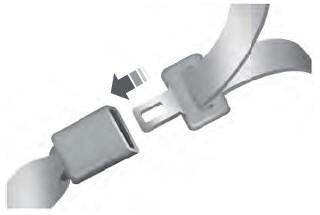
Fastening the Seatbelts
The front outboard and rear safety restraints in the vehicle are combination lap and shoulder belts.
Insert the belt tongue into the proper buckle (the buckle closest to the direction the tongue is coming from) until you hear a snap and feel it latch. Make sure that you securely fasten the tongue in the buckle.