
Lincoln Aviator: Seatbelts / Principle of Operation
WARNING: Always drive and ride with your seatback upright and the lap belt snug and low across the hips.
WARNING: Children must always be properly restrained.
WARNING: Do not allow a passenger to hold a child on their lap when your vehicle is moving. Failure to follow this instruction could result in personal injury or death in the event of a sudden stop or crash.
WARNING: All occupants of your vehicle, including the driver, should always properly wear their seatbelts, even when an airbag supplemental restraint system is provided. Failure to properly wear your seatbelt could seriously increase the risk of injury or death.
WARNING: It is extremely dangerous to ride in a cargo area, inside or outside of a vehicle. In a crash, people riding in these areas are more likely to be seriously injured or killed. Do not allow people to ride in any area of your vehicle that is not equipped with seats and seatbelts. Make sure everyone in your vehicle is in a seat and properly using a seatbelt. Failure to follow this warning could result in serious personal injury or death.
WARNING: In a rollover crash, an unbelted person is significantly more likely to die than a person wearing a seatbelt.
WARNING: Each seating position in your vehicle has a specific seatbelt assembly made up of one buckle and one tongue designed to be used as a pair. Use the shoulder belt on the outside shoulder only. Never wear the shoulder belt under the arm. Never use a single seatbelt for more than one person.
WARNING: Even with advanced restraints systems, properly restrain children 12 and under in a rear seating position. Failure to follow this could seriously increase the risk of injury or death.
WARNING: Seatbelts and seats may be hot in a vehicle that is in the sunshine. The hot seatbelts or seats may burn a small child. Check seat covers and buckles before you place a child anywhere near them.
All seating positions in your vehicle have lap and shoulder seatbelts. All occupants of the vehicle should always properly wear their seatbelts, even when an airbag supplemental restraint system is provided.
The seatbelt system consists of:
- Lap and shoulder seatbelts.
- Shoulder seatbelt with automatic locking mode, (except driver seatbelt).
- Height adjuster at the front outermost seating positions.
- Seatbelt pretensioners at the front outermost and second row outermost seating positions.
- Belt tension sensor at the front outermost passenger seating position.

- Seatbelt warning light and chime.

- Crash sensors and monitoring system with readiness indicator.
The seatbelt pretensioners are designed to tighten the seatbelts when activated. In frontal and near-frontal crashes, the seatbelt pretensioners may be activated alone or, if the crash is of sufficient severity, together with the front airbags. The pretensioners may also activate when a Safety Canopy airbag deploys.
 Seatbelts
..
 Fastening the Seatbelts
The front outboard and rear safety restraints
in the vehicle are combination lap and
shoulder belts.
Insert the belt tongue into the proper
buckle (the buckle closest to the direction
the tongue is coming from) until you hear
a snap and feel it latch...
Other information:
Lincoln Aviator 2020-2026 Service Manual: Diagnosis and Testing - Stoplamps
Diagnostic Trouble Code (DTC) Chart Diagnostics in this manual assume a certain skill level and knowledge of Ford-specific diagnostic practices. REFER to: Diagnostic Methods (100-00 General Information, Description and Operation). Diagnostic Trouble Code Chart Module DTC Description Action BCM B1115:11 High Mounted Stop Lamp Control: Circuit Short To Ground GO to Pinpoint Test B BCM B1115:15 High Mounted Stop Lamp Control: Circuit Short To Battery Or Open GO to Pinpoint Test B BCM B1444:11 Left Rear Stop/Position Lamp Output: Circuit Short To Ground GO to Pinpoint Test B BCM B1444:15 Left Rear Stop/Position Lamp Output: Circuit Short To Battery or Open GO to Pinpoint Test B BCM B1448:11 Right Rear Stop/Position Lamp Output: Circuit Short To Ground GO to Pinpoint Test B BCM B1448:15 Right Rear Stop/Position Lamp Output: Circuit Short To Battery or Open GO to Pinpoint Test B BCM B14A0:11 Left Tailgate/Liftgate Lamps: Circuit Short to Ground GO to Pinpoint Test B BCM B14A0:15 Left Tailgate/Liftgate Lamps: Circuit Short to Battery or Open GO to Pinpoint Test B BCM B14A1:11 Right Tailgate/Liftgate Lamps: Circuit Short to Ground GO to Pinpoint Test B BCM B14A1:15 Right Tailgate/Liftgate Lamps: Circuit Short to Battery or Open GO to Pinpoint Test B BCM C0040:12 Brake Pedal Switch "A": Circuit Short To Battery GO to Pinpoint Test A Symptom Charts Symptom Chart: Stoplamps Diagnostics in this manual assume a certain skill level and knowledge of Ford-specific diagnostic practices...
Lincoln Aviator 2020-2026 Service Manual: Removal and Installation - Temperature Door Actuator
Removal Fully lower the glove compartment. Disconnect the check strap. Push the stop tabs inward. Remove the screws and the temperature door actuator. Disconnect the electrical connector...
Categories
- Manuals Home
- Lincoln Aviator Owners Manual
- Lincoln Aviator Service Manual
- Fuel Quality
- Tire Change Procedure
- Locking and Unlocking
- New on site
- Most important about car
Locking and Unlocking the Doors from Inside
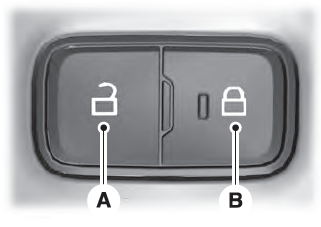
Locking the Doors
Press the lock switch on the door interior trim panel. The doors can no longer be released using the exterior door handle switches and the luggage compartment locks.
