
Lincoln Aviator 2020-2026 Service Manual / Powertrain / Engine / Evaporative Emissions - 3.0L EcoBoost / Removal and Installation - Fuel Vapor Vent Valve
Lincoln Aviator: Evaporative Emissions - 3.0L EcoBoost / Removal and Installation - Fuel Vapor Vent Valve
Removal
NOTE: Removal steps in this procedure may contain installation details.
-
With the vehicle in NEUTRAL, position it on a hoist.
Refer to: Jacking and Lifting (100-02 Jacking and Lifting, Description and Operation).
-
-
Remove the fasteners.
Torque: 53 lb.in (6 Nm)
-
Remove the fastener.
Torque: 22 lb.in (2.5 Nm)
-
Remove the pushpins.
-
Remove the fasteners.
-
Remove the fasteners.
-
Remove the fasteners.
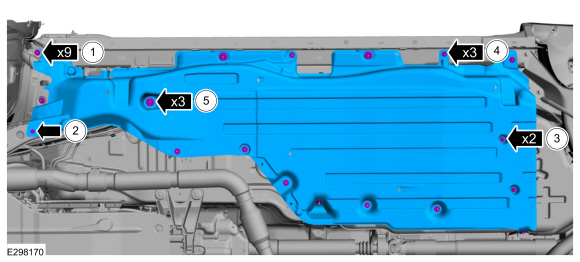 |
-
-
Disconnect the electrical connector.
-
Disconnect the quick connect couplings.
Refer to: Quick Release Coupling (310-00A Fuel System - General Information - 3.0L EcoBoost, General Procedures).
-
Remove the fuel vapor vent valve.
-
Disconnect the electrical connector.
 |
Installation
-
To install, reverse the removal procedure.
 Removal and Installation - Evaporative Emission Canister Vent Solenoid
Removal
NOTE:
Removal steps in this procedure may contain installation details.
With the vehicle in NEUTRAL, position it on a hoist.
Refer to: Jacking and Lifting (100-02 Jacking and Lifting, Description and Operation)...
 Removal and Installation - Fuel Tank Pressure Sensor and Tube
Special Tool(s) /
General Equipment
Transmission Jack
Removal
NOTE:
Removal steps in this procedure may contain installation steps.
Disconnect the battery...
Other information:
Lincoln Aviator 2020-2026 Service Manual: Removal and Installation - Fender
Special Tool(s) / General Equipment Knife Materials Name Specification Flexible Foam Repair3M™ 08463, LORD Fusor® 121 - Removal NOTE: Removal steps in this procedure may contain installation details. NOTE: RH shown, LH similar...
Lincoln Aviator 2020-2026 Service Manual: Diagnosis and Testing - Charging System
Diagnostic Trouble Code (DTC) Chart Diagnostics in this manual assume a certain skill level and knowledge of Ford-specific diagnostic practices. REFER to: Diagnostic Methods (100-00 General Information, Description and Operation). Diagnostic Trouble Code Chart Module DTC Description Action BCM B11DB:02 Battery Monitoring Module "A": General Signal Failure GO to Pinpoint Test F BCM B11DB:08 Battery Monitoring Module "A": Bus Signal/Message Failures GO to Pinpoint Test F BCM B11DB:09 Battery Monitoring Module "A": Component Failures GO to Pinpoint Test F BCM B11DB:11 Battery Monitoring Module "A": Circuit Short To Ground GO to Pinpoint Test F BCM B11DB:49 Battery Monitoring Module "A": Internal Electronic Failure GO to Pinpoint Test I BCM B11DB:55 Battery Monitoring Module "A": Not Configured GO to Pinpoint Test J BCM B1489:11 Battery Monitoring System (BMS) Sensor Power: Circuit Short To Ground GO to Pinpoint Test F PCM P0562:00 System Voltage Low: No Sub Type Information GO to Pinpoint Test B PCM P0563:00 System Voltage High: No Sub Type Information GO to Pinpoint Test A PCM P065B:00 Generator "A" Control Circuit Range/Performance: No Sub Type Information GO to Pinpoint Test B PCM P065C:00 Generator "A" Mechanical Performance: No Sub Type Information GO to Pinpoint Test B PCM P0A3B:00 Generator "A" Over Temperature: No Sub Type Information GO to Pinpoint Test K PCM P0A5A:00 Generator Current Sensor Circuit Range/Performance: No Sub Type Information GO to Pinpoint Test E PCM P0A5B:00 Generator Current Sensor Circuit Low: No Sub Type Information GO to Pinpoint Test E PCM P0A5C:00 Generator Current Sensor Circuit High: No Sub Type Information GO to Pinpoint Test E PCM U012D:00 Lost Communication With Generator "A" Control Module: No Sub Type Information GO to Pinpoint Test G PCM U042E:00 Invalid Data Received From Generator "A" Control Module: No Sub Type Information GO to Pinpoint Test G Inspection and Verification Verify the customer concern by operating the charging system...
Categories
- Manuals Home
- Lincoln Aviator Owners Manual
- Lincoln Aviator Service Manual
- Description and Operation - Jacking and Lifting
- Child Safety Locks
- Body and Paint
- New on site
- Most important about car
Seatbelt Height Adjustment
WARNING: Position the seatbelt height adjuster so that the seatbelt rests across the middle of your shoulder. Failure to adjust the seatbelt correctly could reduce its effectiveness and increase the risk of injury in a crash.
Adjust the height of the shoulder belt so the belt rests across the middle of your shoulder. Slide the adjuster up to raise the belt. Press the button and slide it down to lower the belt.
Copyright © 2026 www.liaviator2.com