
Lincoln Aviator: Pedestrian Alert System / Description and Operation - Pedestrian Alert System - System Operation and Component Description
System Operation
System Diagram
.jpg)
.jpg)
| Item | Description |
|---|---|
| 1 | PACM |
| 2 | PCM |
| 3 | IPC |
| 4 | Rear sounder |
| 5 | BCM |
| 6 | SOBDMC |
| 7 | Front sounder |
Network Message Charts
Module Network Input Messages - PACM
| Broadcast Message | Originating Module | Message Purpose |
|---|---|---|
| Factory mode | BCM | Controls the pedestrian alert system based on the vehicle build status set in factory mode. |
| Ignition status | BCM | Ignition RUN, START and accessory states required for the PACM operating modes and fault reporting. |
| Power pack status | SOBDMC | Determines the HEV operational state. |
| Reverse gear state | PCM | Determines reverse gear state. |
| Transport mode | BCM | Controls the pedestrian alert system based on the vehicle build status set in transport mode. |
| Vehicle speed | PCM | Engages the sounder between 0-30 km/h (0-8 mph). |
Module Network Input Messages - IPC
| Broadcast Message | Originating Module | Message Purpose |
|---|---|---|
| Pedestrian alert fault | PACM | Displays the pedestrian sounder fault warning message. |
Pedestrian Alert System
The pedestrian alert system provides an audible alert when the vehicle is moving in forward or reverse between 0-30 km/h (0-8 mph). The PACM receives all network messages required to operate the system over the HS-CAN1.
In the event of a system fault, the IPC message center displays the Pedestrian Alert Fault Service Now warning message in the message center. The IPC receives the pedestrian alert fault message from the GWM over the HS-CAN3. The GWM receives the pedestrain alert fault message from the PACM over the HS-CAN1.
Component Description
PACM
The PACM controls the pedestrian alert system and is capable of setting Diagnostic Trouble Codes (DTCs) when a fault condition is detected. The PACM requires PMI when replaced.
 Description and Operation - Pedestrian Alert System - Overview
Overview
Due
to the quiet nature of vehicles operating in electric mode, pedestrians
may not be aware of the presence and operation of the vehicle, creating
a risk for injury...
 Diagnosis and Testing - Pedestrian Alert System
Diagnostic Trouble Code (DTC) Chart
Diagnostics in this manual assume a certain skill level and knowledge of Ford-specific diagnostic practices. REFER to: Diagnostic Methods (100-00 General Information, Description and Operation)...
Other information:
Lincoln Aviator 2020-2026 Service Manual: Removal and Installation - Brake Caliper Anchor Plate
Removal NOTE: Removal steps in this procedure may contain installation details. Remove the brake pads. Refer to: Brake Pads (206-03 Front Disc Brake, Removal and Installation). Remove the bolts and the anchor plate. Discard the bolts Torque: 129 lb...
Lincoln Aviator 2020-2026 Service Manual: Removal and Installation - Rear Parking Aid Camera Washer Jet
Removal NOTE: Removal steps in this procedure may contain installation details. Remove the rear parking aid camera. Refer to: Rear Parking Aid Camera (413-13B Parking Aid - Vehicles With: Parking Aid Camera, Removal and Installation). Release the clips and remove the rear parking aid camera washer jet...
Categories
- Manuals Home
- Lincoln Aviator Owners Manual
- Lincoln Aviator Service Manual
- Opening and Closing the Hood
- Locking and Unlocking
- Disabling Auto-Start-Stop
- New on site
- Most important about car
Remote Control
Passive Key
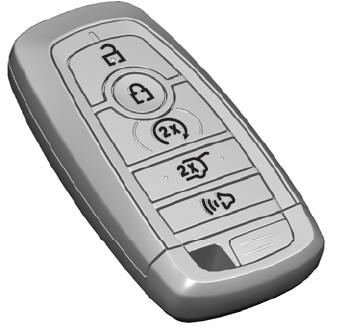
The passive key operates the power locks and the remote start system. The passive key must be in your vehicle to use the push button start.
Note: You may not be able to shift out of park (P) unless the passive key is inside your vehicle.
