Lincoln Aviator: Seatbelt Systems / Description and Operation - Seatbelt Systems - System Operation and Component Description
System Operation
Emergency Locking Retractor (ELR)
All
retractors have an Emergency Locking Retractor (ELR) mode, which is a
vehicle-sensitive feature designed to activate and lock the seatbelt
webbing during hard braking, cornering, or an impact of approximately 24
km/h (15 mph). The Emergency Locking Retractor (ELR) feature helps
reduce the forward movement of the driver and passengers. For testing,
see Functional Test - Seatbelt Retractor, Road Test Inspection.
Refer to: Seatbelt Systems (501-20A Seatbelt Systems, Diagnosis and Testing).
Automatic Locking Retractor (ALR)
The
Automatic Locking Retractor (ALR) mode is used when locking a child
seat in any passenger seating position. The Automatic Locking Retractor
(ALR) mode automatically activates when the seatbelt webbing is fully
extracted from the retractor and then allowed to retract. As the
seatbelt webbing retracts back onto the spool, an audible clicking sound
is made, indicating the seatbelt retractor is in Automatic Locking
Retractor (ALR) mode and the seatbelt webbing cannot pull back out of
the seatbelt retractor. The Automatic Locking Retractor (ALR) mode
disengages when the webbing is allowed to fully retract back into the
retractor. For testing, see Functional Test - Seatbelt Retractor,
Automatic Locking Retractor (ALR) Mode.
Refer to: Seatbelt Systems (501-20A Seatbelt Systems, Diagnosis and Testing).
Seatbelt Warning Chime and Indicator
For seatbelt warning chime and indicator operation,
Refer to: Warning Chimes - System Operation and Component Description (413-01 Instrumentation, Message Center and Warning Chimes, Description and Operation).
To diagnose the seatbelt warning chime and indicator,
Refer to: Instrumentation, Message Center and Warning Chimes - Vehicles With: Head Up Display (HUD) (413-01 Instrumentation, Message Center and Warning Chimes, Diagnosis and Testing).
Belt-Minder®
For Belt-Minder® operation,
Refer to: Warning Chimes - System Operation and Component Description (413-01 Instrumentation, Message Center and Warning Chimes, Description and Operation).
To diagnose the Belt-Minder® feature,
Refer to: Instrumentation, Message Center and Warning Chimes - Vehicles With: Head Up Display (HUD) (413-01 Instrumentation, Message Center and Warning Chimes, Diagnosis and Testing).
To activate or deactivate the Belt-Minder® feature,
Refer to: Seatbelt Minder Deactivating/Activating (413-01 Instrumentation, Message Center and Warning Chimes, General Procedures).
Component Description
Child Safety Seat Tether Anchor
Child safety seat tether anchors are provided at all second and third row seat positions. They are part of the seat backrest frame and cannot be serviced separately. Install a new backrest frame.
If a child safety seat was in use during a collision, inspect the child safety seat tether anchor and mounting areas and restore the vehicle to the original production configuration.
Child Safety Seat Tether Anchor - Lower Anchors and Tethers for Children (LATCH)
Lower Anchors and Tethers for Children (LATCH) are located at the second row outboard seating positions and at both third row seating positions. For second row seating, they are part of the seat cushion frame. For third row, they are part of the seat backrest frame. LATCH cannot be serviced separately. Install a new seat cushion frame or seat backrest frame.
If a child safety seat was in use during a collision, inspect the LATCH and restore the vehicle to the original production configuration.

 Diagnosis and Testing - Seatbelt Systems
Symptom Chart(s)
Preliminary Inspection
Diagnostics in this manual assume a certain skill level and knowledge of Ford-specific diagnostic practices...
Other information:
Lincoln Aviator 2020-2026 Owners Manual: Information Display Control and Horn
I..
Lincoln Aviator 2020-2026 Service Manual: Removal and Installation - Steering Column
Removal NOTICE: To prevent damage to the clockspring, make sure the front wheels are in the straight-ahead position. NOTICE: Precise tolerances are required when manufacturing a steering column. Never install a repaired, rebuilt, aftermarket, or remanufactured steering column...
Categories
- Manuals Home
- Lincoln Aviator Owners Manual
- Lincoln Aviator Service Manual
- Changing the Front Wiper Blades - Vehicles With: Heated Wiper Blades
- Description and Operation - Jacking and Lifting
- Disabling Auto-Start-Stop
- New on site
- Most important about car
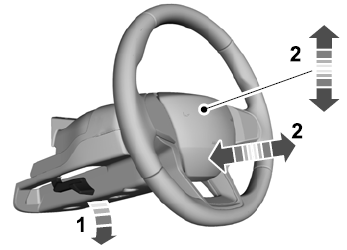
Adjusting the Steering Wheel - Vehicles With: Manual Adjustable Steering Column
WARNING: Do not adjust the steering wheel when your vehicle is moving.
Note: Make sure that you are sitting in the correct position.
Unlock the steering column. Adjust the steering wheel to the desired position.