Lincoln Aviator: Auto-Start-Stop - Excluding: Plug-In Hybrid Electric Vehicle (PHEV) / Enabling Auto-Start-Stop
The system automatically enables every time you start your vehicle if:
- Your vehicle exceeds an initial speed of 3 mph (5 km/h) after you have initially started your vehicle.
- You have stopped your vehicle.
- Your foot is on the brake pedal.
- The driver door is closed.
- The interior compartment has cooled or warmed to an acceptable level.
- The front windshield defroster is off.
- You have not turned the steering wheel rapidly or you do not have it at a sharp angle.
- The vehicle is not on a steep road grade.
- The battery is within optimal operating conditions (battery state of charge and temperature in range).
- The engine coolant is near operating temperature.
- Elevation is below about 12,000 ft (3,650 m).
- Ambient temperature is moderate.
- The trailer is not connected.
- If you select Normal, Conserve, or Slippery.
- You are not in 4H or 4L.
- You have not selected Manual shift mode.
- Hill descent control is not active.
- You have not selected Tow haul, Excite, Deep, or Slow Climb.
Note: When in Excite mode, Start/Stop can be enabled by pressing the Auto-Start-Stop button.
 The green Auto-Start-Stop
indicator light on the instrument
cluster will illuminate to indicate
when the automatic engine stop occurs.
The green Auto-Start-Stop
indicator light on the instrument
cluster will illuminate to indicate
when the automatic engine stop occurs.
 If the instrument cluster is
equipped with a grey
Auto-Start-Stop indicator light, it
illuminates when automatic engine stop is
not available due to one of the above noted
conditions not being met.
If the instrument cluster is
equipped with a grey
Auto-Start-Stop indicator light, it
illuminates when automatic engine stop is
not available due to one of the above noted
conditions not being met.
Automatic Engine Restart
Any of the following conditions will result in an automatic restart of the engine:
- You have removed your foot from the brake pedal.
- You press the accelerator pedal.
- You press the accelerator and the brake pedal at the same time.
- The driver safety belt becomes unfastened or the driver door is ajar.
- Your vehicle is moving.
- The interior compartment does not meet customer comfort when air conditioning or heat is on.
- Fogging of the windows could occur and the air conditioning is on.
- The battery is not within optimal operating conditions.
- You have exceeded the maximum engine off time.
- When you press the Auto-Start-Stop button with the engine automatically stopped.
- The front defroster is turned to the Max setting.
- When you shift into park (P), the engine will restart.
Any of the following conditions may result in an automatic restart of the engine:
- You have increased the blower fan speed or changed the climate control temperature.
- You have an electrical accessory turned on or plugged in.
Note: You may notice that the climate seat fan fluctuates during an automatic restart.
 Auto-Start-Stop - Excluding: Plug-In Hybrid Electric Vehicle (PHEV)
The system helps reduce fuel consumption
by automatically stopping and restarting the
engine when your vehicle has stopped. The
engine restarts automatically when you
release the brake pedal...
 Disabling Auto-Start-Stop
Press the button on the
instrument
panel to access the
Auto-Start-Stop feature on the
touchscreen. Use the touchscreen to
deactivate the feature...
Other information:
Lincoln Aviator 2020-2026 Service Manual: Removal and Installation - Body Control Module C (BCMC)
Removal NOTE: Removal steps in this procedure may contain installation details. NOTE: If the BCMC did not respond to the diagnostic scan tool, As-Built Data may need to be entered as part of the repair. This step is only necessary if the BCMC is being replaced...
Lincoln Aviator 2020-2026 Service Manual: Description and Operation - Third Row Seats - Overview
Overview Third Row Power Fold Seats Pressing and releasing the power fold seat control switch (located in the rear cargo area on the RH loadspace trim panel) causes the corresponding third row seat backrest(s) to fold forward for additional cargo space...
Categories
- Manuals Home
- Lincoln Aviator Owners Manual
- Lincoln Aviator Service Manual
- Body and Paint
- Remove and Reinstall the Battery
- Description and Operation - Body and Frame
- New on site
- Most important about car
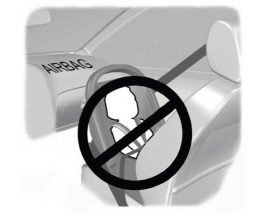
Children and Airbags
WARNING: Airbags can kill or injure a child in a child restraint. Never place a rear-facing child restraint in front of an active airbag. If you must use a forward-facing child restraint in the front seat, move the seat upon which the child restraint is installed all the way back.