
Lincoln Aviator: Instrument Cluster / Gauges
Note: Clusters shown in single gauge view.
Note: Displays may appear slightly different depending on region.
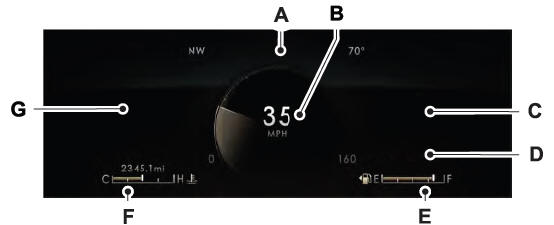
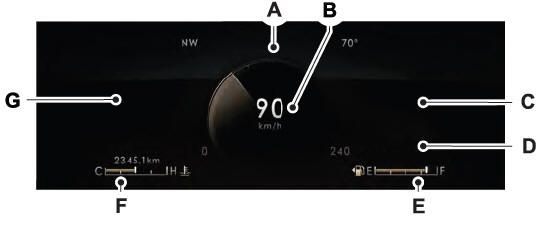
- Status Bar.
- Speedometer.
- Information on demand.
- Vehicle driving range.
- Fuel and battery gauges.
- Engine coolant temperature gauge.
- Tachometer.
Status Bar
Displays information related to the current audio source, compass direction and outside air temperature.
Information On Demand
Displays selected on-demand information screens.
Fuel Gauge
The fuel gauge indicates about how much fuel is in the fuel tank.
The arrow adjacent to the fuel pump symbol indicates on which side of your vehicle the fuel filler door is located.
Note: The fuel gauge may vary slightly when your vehicle is moving or on a slope.
Low Fuel Reminder
A low fuel level reminder displays and sounds when the distance to empty reaches 75 mi (120 km) to empty for MyKey, and at 50 mi (80 km), 25 mi (40 km), 10 mi (20 km) and 0 mi (0 km) for all vehicle keys.
Note: The low fuel reminder can appear at different fuel gauge positions depending on fuel economy conditions. This variation is normal.
Battery Gauge
The high voltage battery gauge displays the total amount of charge associated with your available electric only driving range. A full fill represents the total amount of energy you can get from an external charge (plugging your vehicle in). When the fill reaches empty the powertrain system automatically switches to hybrid operation.
Vehicle Driving Range
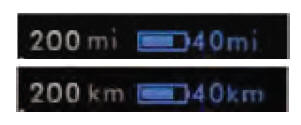
Vehicle range indicates the estimated distance your vehicle will travel with the energy currently onboard. Estimates will vary based on the energy used while driving.
Changes in driving pattern can cause the values to not only decrease but also increase or stay constant for periods of time.
The amount of energy being used while driving is affected by:
- Mild or aggressive acceleration or braking.
- Your vehicle speed.
- Use of accessories such as climate control.
- Ambient temperature and other weather conditions.
- Driving in a city or on a highway.
- Driving on hilly road conditions.
Note: It is normal for vehicle range estimates to vary due to changes in average energy usage. This is why you typically see different range estimates each time you fill up your fuel tank or fully charge your battery.
Gasoline Distance to Empty
Indicates the approximate distance your vehicle can travel on the fuel remaining in the tank.
Electric Range
Indicates the approximate distance your vehicle can travel on electric power only with the engine off.
Engine Coolant Temperature Gauge
WARNING: Do not remove the coolant reservoir cap when the engine is on or the cooling system is hot. Wait 10 minutes for the cooling system to cool down. Cover the coolant reservoir cap with a thick cloth to prevent the possibility of scalding and slowly remove the cap. Failure to follow this instruction could result in personal injury.
Indicates engine coolant temperature. At normal operating temperature, the level indicator is in the normal range. If the engine coolant temperature exceeds the normal range, stop your vehicle as soon as safely possible, switch off the engine and let the engine cool.

 Warning Lamps and Indicators
The following warning lamps and indicators
alert you to a vehicle condition that may
become serious. Some lamps illuminate
when you start your vehicle to make sure
they work...
Other information:
Lincoln Aviator 2020-2026 Service Manual: Removal and Installation - Steering Column Control Switch
Removal NOTE: Removal steps in this procedure may contain installation details. Remove the steering column shrouds. Refer to: Steering Column Shrouds (501-05 Interior Trim and Ornamentation, Removal and Installation). Remove the steering column control switch...
Lincoln Aviator 2020-2026 Service Manual: Diagnosis and Testing - Fuel Tank and Lines
Diagnostic Trouble Code (DTC) Chart Diagnostics in this manual assume a certain skill level and knowledge of Ford-specific diagnostic practices.REFER to: Diagnostic Methods (100-00 General Information, Description and Operation). Diagnostic Trouble Code Chart Module DTC Description Action PCM P008A:00 Low Pressure Fuel System Pressure - Too Low: No Sub Type Information GO to Pinpoint Test HC PCM P008B:00 Low Pressure Fuel System Pressure - Too High: No Sub Type Information GO to Pinpoint Test HC PCM P00BA:00 Low Fuel Pressure - Forced Limited Power: No Sub Type Information GO to Pinpoint Test HC PCM P00BB:00 Fuel Injector Insufficient Flow - Forced Limited Power: No Sub Type Information GO to Pinpoint Test HC PCM P0148:00 Fuel Delivery Error: No Sub Type Information GO to Pinpoint Test HC PCM P0230:00 Fuel Pump Primary Circuit: No Sub Type Information GO to Pinpoint Test KC PCM P0231:00 Fuel Pump Secondary Circuit Low: No Sub Type Information GO to Pinpoint Test KC PCM P0232:00 Fuel Pump Secondary Circuit High: No Sub Type Information GO to Pinpoint Test KC PCM P025A:00 Fuel Pump Module A Control Circuit/Open: No Sub Type Information GO to Pinpoint Test KC PCM P025B:00 Fuel Pump Module A Control Circuit Range/Performance: No Sub Type Information GO to Pinpoint Test KC PCM P025C:00 Fuel Pump Module A Control Circuit Low: No Sub Type Information GO to Pinpoint Test KC PCM P025D:00 Fuel Pump Module A Control Circuit High: No Sub Type Information GO to Pinpoint Test KC PCM P027B:00 Fuel Pump Module B Control Circuit Range/Performance: No Sub Type Information GO to Pinpoint Test KC PCM P0627:00 Fuel Pump A Control Circuit/Open: No Sub Type Information GO to Pinpoint Test KC PCM P064A:00 Fuel Pump Control Module A: No Sub Type Information GO to Pinpoint Test KC PCM P166A:00 Restraints Deployment Communication Circuit: No Sub Type Information GO to Pinpoint Test KC PCM P2632:00 Fuel Pump B Control Circuit/Open: No Sub Type Information GO to Pinpoint Test KC PCM P26EA:00 Fuel Pump Control Module B: No Sub Type Information GO to Pinpoint Test KC PCM U0109:00 Lost Communication With Fuel Pump Control Module A: No Sub Type Information GO to Pinpoint Test KC PCM U016C:00 Lost Communication With Fuel Pump Control Module B: No Sub Type Information GO to Pinpoint Test KC PCM U210B:00 Lost Communication Between Fuel Pump Control Module A And Restraints Control Module: No Sub Type Information GO to Pinpoint Test KC Global Customer Symptom Code (GCSC) Chart Diagnostics in this manual assume a certain skill level and knowledge of Ford-specific diagnostic practices...
Categories
- Manuals Home
- Lincoln Aviator Owners Manual
- Lincoln Aviator Service Manual
- Description and Operation - Jacking and Lifting
- Fuel Quality
- Disabling Auto-Start-Stop
- New on site
- Most important about car
Child Safety Locks
When the child safety locks are set, you cannot open the rear doors from the inside.
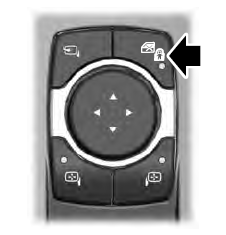
The child safety lock control is on the driver door.
Press the control to switch the child safety locks on. Press the control again to switch them off. A light on the child safety control illuminates when you switch them on.
