Lincoln Aviator: Automatic Transmission - 10-Speed Automatic Transmission – 10R60 / General Procedures - Transmission Fluid Level Check
Check
NOTICE: The vehicle should not be driven if the transmission fluid level is low. Internal failure could result.
NOTE: If the vehicle has been operated for an extended period at high highway speeds, in city traffic, during hot weather or while pulling a trailer, the transmission fluid must cool down to obtain an accurate reading.
NOTE: If a new transmission fluid cooler or new fluid cooler tubes have been installed, drive the vehicle to warm the transmission fluid to 96ºC-101ºC (206ºF-215ºF) in order to purge the air from the transmission fluid cooling system.
-
Connect the diagnostic scan tool and position the vehicle on a hoist.
Refer to: Jacking and Lifting (100-02 Jacking and Lifting - 10-Speed Automatic Transmission - 10R60) .
-
With the engine running, place the transmission selector
lever in each gear position, holding approximately 5 seconds in each
position. Place the transmission selector lever in PARK.
-
Remove the transmission fluid fill plug.
.jpg) |
-
Remove the transmission fluid level indicator from the transmission.
.jpg) |
-
.jpg)
Check the transmission fluid level using the transmission fluid level indicator.
|
-
NOTE: The transmission fluid level indicator uses 1 through 6 to indicate the fluid level. The different numbers are for different vehicle models. Use the area between 3 and 4.5 when checking the transmission fluid level. The correct transmission fluid level is between 3 and 4.5 on the transmission fluid level indicator.
NOTE: Do not overfill the transmission.
Using the scan tool verify the transmission fluid temperature is between 96ºC - 101ºC (206ºF - 215ºF). The transmission fluid level must be between 3 and 4.5 on the transmission fluid level indicator.
.jpg) |
-
If the transmission fluid is not at the correct level,
follow the steps for adding or removing transmission fluid.
Refer to: Transmission Fluid Drain and Refill (307-01 Automatic Transmission - 10-Speed Automatic Transmission - 10R60) .
-
Install the transmission fluid level indicator.
|
-
Install the transmission fluid fill plug.
Torque: 52 lb.ft (70 Nm)
|
 General Procedures - Transmission Fluid Exchange
Special Tool(s) /
General Equipment
Fluid Exchanger
Materials
Name
Specification
Motorcraft® MERCON® ULV Automatic Transmission FluidXT-12-QULV
WSS-M2C949-A, MERCON® ULV
Connect
NOTICE:
Use transmission fluid specific for this transmission...
 General Procedures - Transmission Line Pressure Test
Materials
Name
Specification
Motorcraft® MERCON® ULV Automatic Transmission FluidXT-12-QULV
WSS-M2C949-A, MERCON® ULV
Check
With the vehicle in NEUTRAL, position it on a hoist...
Other information:
Lincoln Aviator 2020-2026 Owners Manual: Recommended Towing Weights
Note: Do not exceed the trailer weight for your vehicle configuration listed in the chart below. Note: Be sure to take into consideration trailer frontal area. Do not exceed 55 ft² (5.11 m²) if your vehicle can tow a class III trailer. Note: Your vehicle could have reduced performance when operating at high altitudes and when heavily loaded or towing a trailer...
Lincoln Aviator 2020-2026 Service Manual: Removal and Installation - Image Processing Module B (IPMB)
Removal NOTE: If installing a new IPMB, it is necessary to upload the module configuration information to the scan tool prior to removing the module. This information must be downloaded into the new IPMB after installation. Using a diagnostic scan tool, begin the PMI process for the IPMB following the onscreen instructions Remove the front scuff plate trim panel...
Categories
- Manuals Home
- Lincoln Aviator Owners Manual
- Lincoln Aviator Service Manual
- Tire Change Procedure
- Drive Modes
- Child Safety Locks
- New on site
- Most important about car
Activating Intelligent Access
The intelligent access key must be within 3 ft (1 m) of the door or luggage compartment you intend to lock or unlock.
At a Door
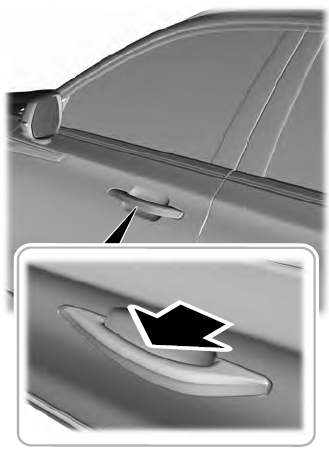
Electronic door handles are on each door. Gently depress the switch inside the exterior door handle to unlock and open the door. An unlock symbol illuminates on the door window trim indicating your vehicle is unlocked.