
Lincoln Aviator 2020-2026 Service Manual / Powertrain / Automatic Transmission / Automatic Transmission - 10-Speed Automatic Transmission – 10R60 / General Procedures - Transmission Line Pressure Test
Lincoln Aviator: Automatic Transmission - 10-Speed Automatic Transmission – 10R60 / General Procedures - Transmission Line Pressure Test
Materials
| Name | Specification |
|---|---|
| Motorcraft® MERCON® ULV Automatic Transmission Fluid XT-12-QULV |
WSS-M2C949-A, MERCON® ULV |
Check
-
With the vehicle in NEUTRAL, position it on a hoist.
Refer to: Jacking and Lifting (100-02 Jacking and Lifting, Description and Operation).
-
NOTE: If equipped.
Remove the bolt.
.jpg) |
-
Remove the bolt, nuts and position aside the transmission fluid cooler.
.jpg) |
-
Remove the line pressure plug.
.jpg) |
-
Inspect the transmission fluid cooler O-ring seals and
install new O-ring seals if necessary. Lubricate the O-ring seals.
Material: Motorcraft® MERCON® ULV Automatic Transmission Fluid / XT-12-QULV (WSS-M2C949-A, ) (MERCON® ULV)
.jpg) |
-
Install the transmission fluid cooler and loosley install the bolt and nuts.
.jpg) |
-
NOTICE: The line pressure tap is an M10 X 1.00 thread. Do not use a National Pipe Thread (NPT) fitting when installing a pressure gauge. If a NPT fitting is used, damage to the transmission case will occur.
-
Connect a Transmission Fluid Pressure Gauge with a M10 X 1.00 fitting.
-
Start the engine and check the line pressures. Refer
to the Line Pressure Chart to determine if the line pressure is within
specification.
Refer to: Special Testing Procedures (307-01A Automatic Transmission - 10-Speed Automatic Transmission – 10R60, Diagnosis and Testing).
-
Connect a Transmission Fluid Pressure Gauge with a M10 X 1.00 fitting.
-
Remove the bolt, nuts and position aside the transmission fluid cooler.
|
-
Remove the Transmission Fluid Pressure Gauge and install the line pressure plug.
Torque: 97 lb.in (11 Nm)
|
-
NOTICE: Make sure the oil cooler is completely installed against the transmission before tightening, or damage to the cooler could result.
Install the transmission fluid cooler and loosely install the bolt and the nuts by hand.
|
-
NOTICE: Make sure the oil cooler is completely installed against the transmission before tightening, or damage to the cooler could result.
Tighten the bolt and nuts in the sequence shown.
Torque: 18 lb.ft (25 Nm)
.jpg) |
-
NOTE: If equipped.
Install the bolt.
Torque: 18 lb.ft (25 Nm)
|
 General Procedures - Transmission Fluid Level Check
Check
NOTICE:
The vehicle should not be driven if the transmission fluid level is low. Internal failure could result.
NOTE:
If the vehicle has been operated for an extended period at
high highway speeds, in city traffic, during hot weather or while
pulling a trailer, the transmission fluid must cool down to obtain an
accurate reading...
 General Procedures - Transmission Strategy Download
Programming
This procedure should be performed when a new
transmission or main control valve body is installed in the vehicle.
13 - digit solenoid body strategy
12 - digit solenoid body identification
If a new main control was installed, record the
13-digit solenoid body strategy from the replacement solenoid body tag
provided with the main control service kit...
Other information:
Lincoln Aviator 2020-2026 Service Manual: Removal and Installation - Air Suspension Compressor
Removal WARNING: Vent all air pressure from the air suspension system prior to disconnecting or removing any air suspension components. It is dangerous to remove air suspension components while under pressure. Failure to follow this instruction may result in serious personal injury...
Lincoln Aviator 2020-2026 Service Manual: Diagnosis and Testing - Preliminary Inspection
Overview The preliminary inspection is part of Automatic Transmission Diagnosis. The preliminary inspection is used to find obvious causes of transmission concerns. To correctly diagnose a concern, first understand the customer concern or condition...
Categories
- Manuals Home
- Lincoln Aviator Owners Manual
- Lincoln Aviator Service Manual
- Body and Paint
- Remove and Reinstall the Battery
- Child Safety Locks
- New on site
- Most important about car
Adjusting the Steering Wheel - Vehicles With: Manual Adjustable Steering Column
WARNING: Do not adjust the steering wheel when your vehicle is moving.
Note: Make sure that you are sitting in the correct position.
Unlock the steering column. Adjust the steering wheel to the desired position.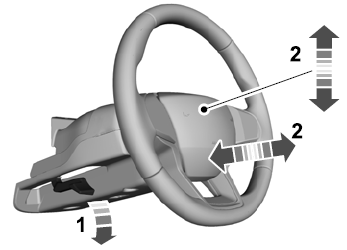

Copyright © 2026 www.liaviator2.com