
Lincoln Aviator: Liftgate / Obstacle Detection and Switching the Power Liftgate On or Off
Obstacle Detection
Note: Entering your vehicle while the liftgate is closing can cause your vehicle to bounce and activate obstacle detection. To prevent this, let the power liftgate close completely before you enter your vehicle. Before driving off, check the instrument cluster for a liftgate or door ajar message or warning indicator. Failure to do this could result in unintentionally leaving the liftgate open while driving.
When Closing
The system stops when it detects an obstacle. A tone sounds and the system reverses to open. Once you remove the obstacle, you can power close the liftgate.
When Opening
The system stops when it detects an obstacle and a tone sounds. Once you remove the obstacle, you can continue to operate the liftgate.
Switching the Power Liftgate On or Off
You can switch the power liftgate on or off through the vehicle settings on your touchscreen.
When switched off, the liftgate only unlatches and will not power open or close.
 Setting the Liftgate Open Height
Open the liftgate.
Stop the liftgate movement by pressing
the control button on the liftgate when it
reaches the desired height.Note: Once the liftgate has stopped
moving,
you can also manually move it to the desired
height...
 Hands-Free Feature (If Equipped)
Make sure you have the passive key within
3 ft (1 m) of the liftgate.
Stand behind your vehicle, and face the
liftgate.
Move your foot, in a single-kick motion,
without pausing, under and away from
the rear bumper detection area...
Other information:
Lincoln Aviator 2020-2026 Service Manual: General Procedures - High Voltage System De-energizing
Depower WARNING: To prevent the risk of high-voltage shock, always follow precisely all warnings and service instructions, including instructions to depower the system. The high-voltage system utilizes approximately 450 volts DC, provided through high-voltage cables to its components and modules...
Lincoln Aviator 2020-2026 Service Manual: Description and Operation - Parking Aid - Overview
Parking Aid Overview Parking Aid - Audible The available parking aid features depend on the vehicle trim level and options selected. The possible audio parking aid configurations are as follows: Front and rear parking aid Front and rear parking aid, plus active park assist and the side sensing system (also known as flank guard) The rear parking aid system sounds a warning tone through the rear audio speakers to alert the driver of stationary objects near the rear bumper when the vehicle is in reverse...
Categories
- Manuals Home
- Lincoln Aviator Owners Manual
- Lincoln Aviator Service Manual
- Tire Change Procedure
- Locking and Unlocking
- Changing the Front Wiper Blades - Vehicles With: Heated Wiper Blades
- New on site
- Most important about car
Child Seats
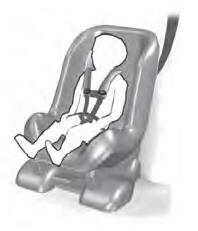
Use a child restraint (sometimes called an infant carrier, convertible seat, or toddler seat) for infants, toddlers and children weighing 40 lb (18 kg) or less (generally four-years-old or younger).
Using Lap and Shoulder Belts
WARNING: Do not place a rearward facing child restraint in front of an active airbag. Failure to follow this instruction could result in personal injury or death.
