
Lincoln Aviator 2020-2026 Service Manual / Electrical / Information and Entertainment Systems / Information and Entertainment System - General Information / Removal and Installation - Automotive Audio Bus (AAB) Cable
Lincoln Aviator: Information and Entertainment System - General Information / Removal and Installation - Automotive Audio Bus (AAB) Cable
Removal
NOTE: Removal steps in this procedure may contain installation details.
NOTE: The original equipment AAB cable is part of the wiring harness and cannot be removed. This procedure refers to replacement of the cable only by overlaying the cable.
-
Remove the loadspace trim panels.
Refer to: Loadspace Trim Panel (501-05 Interior Trim and Ornamentation, Removal and Installation).
-
Disconnect the AAB cable connector.
 |
-
Disconnect the subwoofer electrical connector.
 |
-
Position the subwoofer assembly to access rear connectors.
-
Remove the nut.
Torque: 80 lb.in (9 Nm)
-
Remove the bolts.
Torque: 80 lb.in (9 Nm)
-
Remove the nut.
 |
-
Disconnect the electrical connectors and remove the subwoofer assembly.
 |
Installation
-
Cut the end off the existing cable.
 |
-
Cut the end off the existing cable.
 |
-
Route the new AAB following the routing shown.
-
Secure the new AAB, as necessary, to prevent NVH concerns.
-
Secure the new AAB, as necessary, to prevent NVH concerns.
 |
-
To install, reverse the removal procedure.
 Removal and Installation - Audio Unit Antenna Cable
Removal
NOTE:
Removal steps in this procedure may contain installation details.
NOTE:
The original equipment antenna cables arepart of the wiring
harnesses and cannot be removed...
 Removal and Installation - Cellular Antenna Cable
Removal
NOTE:
Removal steps in this procedure may contain installation details.
All vehicles
Lower the headliner.
Refer to: Headliner - Lowering (501-05 Interior Trim and Ornamentation, Removal and Installation)...
Other information:
Lincoln Aviator 2020-2026 Owners Manual: Driving to Optimize Fuel Economy
Note: Having your engine running is not always an indication of inefficiency. In some cases, it is actually more efficient than driving in electric mode. Your fuel economy should improve throughout your hybrid's break-in period. As with any vehicle, your driving habits and accessory usage can significantly impact your fuel economy...
Lincoln Aviator 2020-2026 Service Manual: Description and Operation - Airbag and Seatbelt Pretensioner Supplemental Restraint System (SRS) - Overview
Overview The RCM continually receives and monitors inputs from the OCSM and various other hard-wired switches and sensors. If the RCM detects a sudden vehicle deceleration and/or lateral deceleration based on the information received from the various sensors and determines that deployment is necessary, it applies voltage and current to deploy the appropriate SRS components...
Categories
- Manuals Home
- Lincoln Aviator Owners Manual
- Lincoln Aviator Service Manual
- Body and Paint
- Disabling Auto-Start-Stop
- Changing the Front Wiper Blades - Vehicles With: Heated Wiper Blades
- New on site
- Most important about car
Fastening the Seatbelts
The front outboard and rear safety restraints in the vehicle are combination lap and shoulder belts.
Insert the belt tongue into the proper buckle (the buckle closest to the direction the tongue is coming from) until you hear a snap and feel it latch. Make sure that you securely fasten the tongue in the buckle.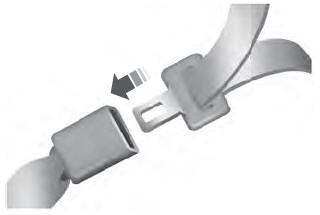

Copyright © 2026 www.liaviator2.com