
Lincoln Aviator: Supplementary Restraints System / Principle of Operation
WARNING: Airbags do not inflate slowly or gently, and the risk of injury from a deploying airbag is the greatest close to the trim covering the airbag module.
WARNING: All occupants of your vehicle, including the driver, should always properly wear their seatbelts, even when an airbag supplemental restraint system is provided. Failure to properly wear your seatbelt could seriously increase the risk of injury or death.
WARNING: Even with advanced restraints systems, properly restrain children 12 and under in a rear seating position. Failure to follow this could seriously increase the risk of injury or death.
WARNING: Do not place your arms on the airbag cover or through the steering wheel. Failure to follow this instruction could result in personal injury.
WARNING: Keep the areas in front of the airbags free from obstruction. Do not affix anything to or over the airbag covers. Objects could become projectiles during airbag deployment or in a sudden stop. Failure to follow this instruction could result in personal injury or death.
WARNING: Airbags can kill or injure a child in a child restraint. Never place a rear-facing child restraint in front of an active airbag. If you must use a forward-facing child restraint in the front seat, move the seat upon which the child restraint is installed all the way back.
WARNING: Do not attempt to service, repair, or modify the supplementary restraint system or associated components. Failure to follow this instruction could result in personal injury or death.
WARNING: Several airbag system components get hot after inflation. To reduce the risk of injury, do not touch them after inflation.
WARNING: If a supplementary restraint system component has deployed, it will not function again. Have the system and associated components inspected as soon as possible. Failure to follow this instruction could result in personal injury or death.
The airbags are a supplemental restraint system and are designed to work with the seatbelts to help protect the driver and right front passenger from certain upper body injuries. Airbags do not inflate slowly; there is a risk of injury from a deploying airbag.
Note: You will hear a loud bang and see a cloud of harmless powdery residue if an airbag deploys. This is normal.
The airbags inflate and deflate rapidly upon activation. After airbag deployment, it is normal to notice a smoke-like, powdery residue or smell the burnt propellant. This may consist of cornstarch, talcum powder (to lubricate the bag) or sodium compounds (for example, baking soda) that result from the combustion process that inflates the airbag. Small amounts of sodium hydroxide may be present which may irritate the skin and eyes, but none of the residue is toxic.
While the system is designed to help reduce serious injuries, contact with a deploying airbag may also cause abrasions or swelling. Temporary hearing loss is also a possibility as a result of the noise associated with a deploying airbag. Because airbags must inflate rapidly and with considerable force, there is the risk of death or serious injuries such as fractures, facial and eye injuries or internal injuries, particularly to occupants who are not properly restrained or are otherwise out of position at the time of airbag deployment. Thus, it is extremely important that occupants be properly restrained as far away from the airbag module as possible while maintaining vehicle control.
Routine maintenance of the airbags is not required.

 Driver and Passenger Airbags
WARNING: Do not place your arms
on the airbag cover or through the steering
wheel. Failure to follow this instruction
could result in personal injury...
Other information:
Lincoln Aviator 2020-2026 Service Manual: Removal and Installation - Front Seat Cushion Extension Adjuster
Removal NOTE: Removal steps in this procedure may contain installation details. NOTE: Driver seat with power head restraint shown, other seats similar. Remove the front seat. Refer to: Front Seat (501-10A Front Seats, Removal and Installation)...
Lincoln Aviator 2020-2026 Service Manual: General Procedures - Refrigerant Oil Adding - Hybrid Electric Vehicle (HEV), Vehicles With: R134A Refrigerant
Special Tool(s) / General Equipment Air Conditioning Service Unit Check NOTICE: Motorcraft® Electric A/C Compressor Oil (YN-32) only must be used as a refrigerant system lubricant for High Voltage Battery Electric vehicles. Addition of any oil other than Motorcraft® Electric A/C Compressor Oil (YN-32) to the High Voltage Battery Electric vehicle refrigerant system will damage the electric A/C compressor and contaminate the refrigerant system...
Categories
- Manuals Home
- Lincoln Aviator Owners Manual
- Lincoln Aviator Service Manual
- Description and Operation - Jacking and Lifting
- Wireless Accessory Charger (If Equipped)
- Configuring The Head Up Display
- New on site
- Most important about car
Child Safety Locks
When the child safety locks are set, you cannot open the rear doors from the inside.
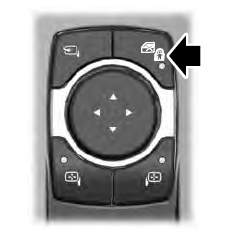
The child safety lock control is on the driver door.
Press the control to switch the child safety locks on. Press the control again to switch them off. A light on the child safety control illuminates when you switch them on.
