
Lincoln Aviator: Supplementary Restraints System / Driver and Passenger Airbags
WARNING: Do not place your arms on the airbag cover or through the steering wheel. Failure to follow this instruction could result in personal injury.
WARNING: Keep the areas in front of the airbags free from obstruction. Do not affix anything to or over the airbag covers. Objects could become projectiles during airbag deployment or in a sudden stop. Failure to follow this instruction could result in personal injury or death.
WARNING: Airbags can kill or injure a child in a child restraint. Never place a rear-facing child restraint in front of an active airbag. If you must use a forward-facing child restraint in the front seat, move the seat upon which the child restraint is installed all the way back.
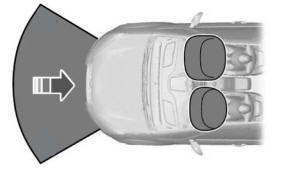
The driver and front passenger airbags will deploy during significant frontal and near frontal crashes.
The driver and passenger front airbag system consists of:
Driver and passenger airbag modules.
Front passenger sensing system.
 Crash sensors and monitoring
system with readiness indicator.
Crash sensors and monitoring
system with readiness indicator.
 Principle of Operation
WARNING: Airbags do not inflate
slowly or gently, and the risk of injury from
a deploying airbag is the greatest close to
the trim covering the airbag module...
 Proper Driver and Front Passenger Seating Adjustment
WARNING: National Highway Traffic
Safety Administration (NHTSA)
recommends a minimum distance of at
least 10 in (25 cm) between an occupant's
chest and the driver airbag module...
Other information:
Lincoln Aviator 2020-2026 Owners Manual: Additional Information Contained on the Tire Sidewall for LT Type Tires
Note: Tire Quality Grades do not apply to this type of tire. LT type tires have some additional information beyond those of P type tires; these differences are described below. LT: Indicates a tire, designated by the Tire and Rim Association, that is intended for service on light trucks...
Lincoln Aviator 2020-2026 Service Manual: Removal and Installation - Rear Air Spring
Removal WARNING: Vent all air pressure from the air suspension system prior to disconnecting or removing any air suspension components. It is dangerous to remove air suspension components while under pressure. Failure to follow this instruction may result in serious personal injury...
Categories
- Manuals Home
- Lincoln Aviator Owners Manual
- Lincoln Aviator Service Manual
- Description and Operation - Body and Frame
- Wireless Accessory Charger (If Equipped)
- Remove and Reinstall the Battery
- New on site
- Most important about car
Remote Control
Passive Key
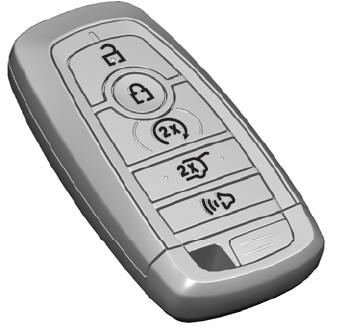
The passive key operates the power locks and the remote start system. The passive key must be in your vehicle to use the push button start.
Note: You may not be able to shift out of park (P) unless the passive key is inside your vehicle.
