Lincoln Aviator: Tire Care / Tire Wear. Damage
Tire Wear
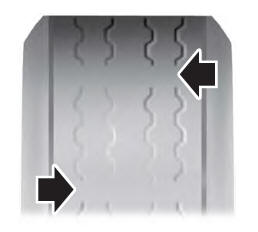
When the tread is worn down to one sixteenth of an inch (2 mm), tires must be replaced to help prevent your vehicle from skidding and hydroplaning. Built-in treadwear indicators, or wear bars, which look like narrow strips of smooth rubber across the tread will appear on the tire when the tread is worn down to one sixteenth of an inch (2 mm).
When the tire tread wears down to the same height as these wear bars, the tire is worn out and must be replaced.
Damage
Periodically inspect the tire treads and sidewalls for damage (such as bulges in the tread or sidewalls, cracks in the tread groove and separation in the tread or sidewall). If damage is observed or suspected, have the tire inspected by a tire professional. Tires can be damaged during off-road use, so inspection after off-road use is also recommended.
 Inspecting Your Tires and Wheel Valve Stems
Periodically inspect the tire treads for
uneven or excessive wear and remove
objects such as stones, nails or glass
that may be wedged in the tread
grooves...
 Age
Age
WARNING: Tires degrade over
time depending on many factors such
as weather, storage conditions, and
conditions of use (load, speed, inflation
pressure) the tires experience
throughout their lives...
Other information:
Lincoln Aviator 2020-2026 Service Manual: Description and Operation - Exhaust System - System Operation and Component Description
System Operation Catalyst And Exhaust Systems The catalytic converter and exhaust systems work together to control the release of harmful engine exhaust emissions into the atmosphere. The engine exhaust gas consists mainly of nitrogen (N), CO2 and water (H2O)...
Lincoln Aviator 2020-2026 Service Manual: Removal and Installation - Interior Rear Door Release Switch
Removal NOTE: LH (left-hand) side shown, RH (right-hand) side similar. Remove the rear door trim panel. Refer to: Rear Door Trim Panel (501-05 Interior Trim and Ornamentation, Removal and Installation). Remove the interior rear door release switch Release the wiring harness routing clips...
Categories
- Manuals Home
- Lincoln Aviator Owners Manual
- Lincoln Aviator Service Manual
- USB Port and Power Point Locations
- Child Safety Locks
- Opening and Closing the Hood
- New on site
- Most important about car
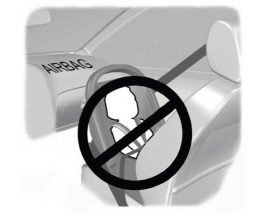
Children and Airbags
WARNING: Airbags can kill or injure a child in a child restraint. Never place a rear-facing child restraint in front of an active airbag. If you must use a forward-facing child restraint in the front seat, move the seat upon which the child restraint is installed all the way back.