
Lincoln Aviator: Maintenance / Changing the Front Wiper Blades - Vehicles Without: Heated Wiper Blades
You can improve poor wiper quality by cleaning the wiper blades and the windshield.
Replace the wiper blades at least annually for optimum performance.
Removing the Front Wiper Blades
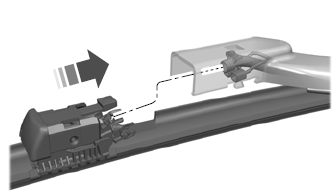
- Lift the wiper blade from the windshield
by holding the middle of the retainer.
Note: Do not hold the wiper blade to lift the wiper arm.
- Rotate the blade toward the windshield by gripping it under the connector until a “click” sound is heard and the wiper blade position is fixed.
- Push the blade release button on top of
the connector and pull the blade from
the arm.
Note: Make sure that the wiper arm does not spring back against the glass when the wiper blade is not attached.
Installing the Front Wiper Blades
- Line up the wiper blade, water and electrical connectors with the receptors on the wiper arm by lifting the arm from the windshield.
- Slide the blade into the connector until a “click” sound is heard.
- Rotate the blade toward the wiper arm by gripping it under the connector until a “click” sound is heard. Verify that the blade has rotation.
Note: Make sure that the wiper blade locks into place.
 Washer Fluid Check. Fuel Filter. Checking the Wiper Blades
Washer Fluid Check
WARNING: If you operate your
vehicle in temperatures below 41.0°F (5°C),
use washer fluid with antifreeze protection.
Failure to use washer fluid with antifreeze
protection in cold weather could result in
impaired windshield vision and increase
the risk of injury or accident...
 Changing the Front Wiper Blades - Vehicles With: Heated Wiper Blades
Replacing the Rubber Insert
Remove the wiper blade.
Use a suitable tool, for example a
screwdriver, to carefully move the tab on
the end cap.
Pull the end cap to release the rubber
insert
To install, reverse the removal procedure...
Other information:
Lincoln Aviator 2020-2026 Owners Manual: Child Restraint and Seatbelt Maintenance
Inspect the vehicle seatbelts and child safety seat systems periodically to make sure they work properly and are not damaged. Inspect the vehicle and child restraint seatbelts to make sure there are no nicks, tears or cuts. Replace if necessary. All vehicle seatbelt assemblies, including retractors, buckles, front seatbelt buckle assemblies, buckle support assemblies (slide bar-if equipped), shoulder belt height adjusters (if equipped), shoulder belt guide on seat backrest (if equipped), child safety seat LATCH and tether anchors, and attaching hardware, should be inspected after a crash...
Lincoln Aviator 2020-2026 Owners Manual: HD Radio™ Information (If Available)
To activate HD radio, please see the Radio Settings in the Settings Chapter. Note: HD Radio broadcasts are not available in all markets. HD Radio technology is the digital evolution of analog AM/FM radio. Your system has a special receiver that allows it to receive digital broadcasts (where available) in addition to the analog broadcasts, it already receives...
Categories
- Manuals Home
- Lincoln Aviator Owners Manual
- Lincoln Aviator Service Manual
- General Procedures - Transmission Fluid Drain and Refill
- Garage Door Opener
- Tire Change Procedure
- New on site
- Most important about car
Child Seats
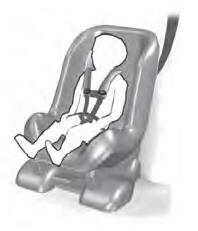
Use a child restraint (sometimes called an infant carrier, convertible seat, or toddler seat) for infants, toddlers and children weighing 40 lb (18 kg) or less (generally four-years-old or younger).
Using Lap and Shoulder Belts
WARNING: Do not place a rearward facing child restraint in front of an active airbag. Failure to follow this instruction could result in personal injury or death.
