Lincoln Aviator: Cruise Control / Description and Operation - Cruise Control - Overview
Overview
The cruise control system is controlled by the PCM.
The cruise control mode is selected from the steering wheel mounted switches which are integrated into the steering wheel. Refer to Owners Literature for additional information.
The cruise control system maintains a selected vehicle speed between 32 kmh (20 mph) or 30 kmh (18 mph) (metric cluster) and the maximum limited vehicle speed. When a MyKey® restricted key is in use and maximum speed limiter is turned on, vehicle speed is limited to 129 kmh (80 mph).
During normal driving, the vehicle speed can vary slightly from the set speed due to road conditions. The vehicle speed can fluctuate when driving up and down a steep hill. If the vehicle speed decreases more than 16 kmh (10 mph) below the set speed, the cruise control disengages.

 Description and Operation - Cruise Control - System Operation and Component Description
System Operation
Non-Adaptive Cruise Control
Item
Description
1
Brake switch assembly
2
IPC
3
Accelerator pedal
4
Deactivator switch
5
Stoplamp switch
6
SCCM
7
PCM
8
Cruise control switches
9
GWM
10
ABS module
11
RCM
12
Steering Effort Control Module (SECM) (adaptive steering)
13
SASM (adaptive steering)
14
SIMA
Network Message Chart
Network Input Messages - IPC
Broadcast Message
Originating Module
Message Purpose
Cruise control override
PCM
Driver overriding cruise control with accelerator pedal...
Other information:
Lincoln Aviator 2020-2026 Service Manual: Removal and Installation - Exterior Front Door Handle
Removal NOTE: LH (left-hand) side shown, RH (right-hand) side similar. NOTE: Removal steps in this procedure may contain installation details. Remove the front door window regulator and motor. Refer to: Front Door Window Regulator and Motor (501-11 Glass, Frames and Mechanisms, Removal and Installation)...
Lincoln Aviator 2020-2026 Service Manual: General Procedures - Tire Pressure Monitoring System (TPMS) Sensor Activation
Special Tool(s) / General Equipment 204-D081A (204-D081) Tire Pressure Monitor (TPMS) Activation NOTE: The tire pressure sensors will go into a "sleep mode" when a vehicle is stationary to conserve battery power. The sensors do not transmit information while in sleep mode...
Categories
- Manuals Home
- Lincoln Aviator Owners Manual
- Lincoln Aviator Service Manual
- USB Port and Power Point Locations
- Resetting the System
- Body and Paint
- New on site
- Most important about car
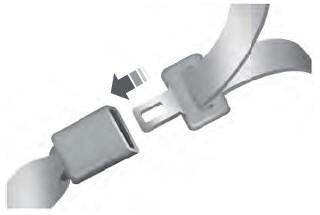
Fastening the Seatbelts
The front outboard and rear safety restraints in the vehicle are combination lap and shoulder belts.
Insert the belt tongue into the proper buckle (the buckle closest to the direction the tongue is coming from) until you hear a snap and feel it latch. Make sure that you securely fasten the tongue in the buckle.