
Lincoln Aviator: Front Drive Axle/Differential / Diagnosis and Testing - Front Drive Axle

Principles of Operation

Inspection and Verification

  1. Verify the customer concern.
  1. Visually inspect for obvious signs of mechanical or electrical damage.
  1. If an obvious cause for an observed or reported concern is found, correct the cause (if possible) before proceeding to the next step.
  1. If the cause is not visually evident, verify the symptom and refer to the Symptom Chart.

Symptom Chart - Front Differential

  Symptom Chart - Front Differential


Condition Possible Sources Actions
Axle overheating
  • Axle lubricant low
  • CHECK the lubricant level. FILL the axle to specification.
    REFER to: Specifications (205-03 Front Drive Axle/Differential, Specifications).
  • Incorrect or contaminated lubrication type
  • INSPECT the axle for damage. REPAIR as necessary. DRAIN and REFILL the axle to specification as necessary.
    REFER to: Specifications (205-03 Front Drive Axle/Differential, Specifications).
  • Bearing preload adjusted too tight
  • If low mileage unit, CHECK the ring and pinion for damage. INSTALL new front axle as necessary
    REFER to: Axle Assembly (205-03 Front Drive Axle/Differential, Removal and Installation).
  • Excessive gear wear
  • INSPECT all the axle gears for wear or damaged. INSTALL new front axle as necessary
    REFER to: Axle Assembly (205-03 Front Drive Axle/Differential, Removal and Installation).
Broken gear teeth on the ring gear or pinion
  • Insufficient lubrication
  • INSTALL a front axle assembly.
    REFER to: Axle Assembly (205-03 Front Drive Axle/Differential, Removal and Installation).
Differential side gears / pinion gears are scored
  • Incorrect or contaminated lubricant type
  • Drain and FILL the axle to specification.
    REFER to: Differential Draining and Filling (205-03 Front Drive Axle/Differential, General Procedures).
    Road test vehicle. If an observable symptom is present (noise from front axle), INSTALL new front axle assembly as necessary.REFER to: Axle Assembly (205-03 Front Drive Axle/Differential, Removal and Installation).
Lubricant leaking from the pinion seal, axle shaft oil seals
  • Vent
  • CLEAN the axle housing vent.
  • Damage in the seal contact area or pinion flange dust shield
  • INSTALL a new pinion nut and the pinion seal if damage is found.
    REFER to: Drive Pinion Seal (205-03 Front Drive Axle/Differential, Removal and Installation).
  • Damage in the seal contact area
  • INSTALL a new halfshaft seal as necessary. Inspect Halfshaft seal contact area. Install new halfshaft as necessary.
    REFER to: Axle Shaft Seal (205-03 Front Drive Axle/Differential, Removal and Installation).
Grease expelling from pinion splines
  • Missing / worn / damaged driveshaft to pinion circlip
  • Missing / Damaged front axle pinion stem O-Ring
  • REMOVE the Front Driveshaft. INSTALL New Circlip and O-Ring. INSTALL the new Front Driveshaft as necessary.
    REFER to: Front Driveshaft (205-01 Driveshaft, Removal and Installation).

Symptom Chart - NVH

NOTE: NVH symptoms should be identified using the diagnostic tools that are available. For a list of these tools, an explanation of their uses and a glossary of common terms, refer to Section 100-04. Since it is possible any one of multiple systems may be the cause of a symptom, it may be necessary to use a process of elimination type of diagnostic approach to pinpoint the responsible system.


REFER to: Noise, Vibration and Harshness (NVH) (100-04 Noise, Vibration and Harshness, Diagnosis and Testing).


  Symptom Chart - NVH


Condition Possible Sources Actions
NVH concern isolated to front axle using proper diagnostic tools. Symptom may be constant or only occurs under specific driving conditions
  • Axle lubricant low or contamination
  • CHECK the lubricant level. FILL the axle to specification.
    REFER to: Differential Fluid Level Check (205-03 Front Drive Axle/Differential, General Procedures).
    OR INSPECT front axle fluid, if required, Drain and FILL the axle to specification. REFER to: Differential Draining and Filling (205-03 Front Drive Axle/Differential, General Procedures).
  • Internal FDU (Front Drive Unit) damage
  • Remove side cover and inspect components for wear or damage. INSTALL a new FDU (Front Drive Unit) as necessary.
    REFER to: Axle Assembly (205-03 Front Drive Axle/Differential, Removal and Installation).
Driveline clunk - loud clunk when shifting from REVERSE to DRIVE
  • Loose or missing fasteners
  • CHECK all driveline fasteners for proper torque.
Driveline clunk — occurs as the vehicle starts to move forward following a stop
  • Loose front axle mount
  • CHECK the front axle for loose bolts. TIGHTEN to proper torque.
    REFER to: Axle Assembly (205-03 Front Drive Axle/Differential, Removal and Installation).
Driveline clunk — occurs during acceleration or from cruise to coast / deceleration
  • Rear driveshaft U-joint
  • Missing or damaged circlip on front axle pinion.
  • INSPECT the rear driveshaft U-joints for wear or damage. INSTALL a new rear driveshaft as necessary.
    REFER to: Rear Driveshaft (205-01 Driveshaft, Removal and Installation).
  • Install new circlip.
Grunting — normally associated with a shudder experienced during acceleration from a complete stop
  • Rear Driveshaft
  • INSPECT the rear Driveshaft. INSTALL the new rear Driveshaft.
    REFER to: Rear Driveshaft (205-01 Driveshaft, Removal and Installation).
Scraping noise — a continuous low pitched noise starting at low speeds
  • Intermediate shaft LH halfshaft seal deflector bent / damaged
  • INSPECT components for wear/damage. INSTALL a new LH Halfshaft seal as necessary.
    REFER to: Axle Shaft Seal (205-03 Front Drive Axle/Differential, Removal and Installation).
Driveline shudder – occurs during acceleration from a slow speed or stop
  • Rear driveshaft
  • INSPECT the rear Driveshaft. INSTALL the new rear Driveshaft.
    REFER to: Rear Driveshaft (205-01 Driveshaft, Removal and Installation).

Axle Fluid Analysis

The appearance of milky fluid could be caused by fluid contamination. Drain and refill fluid and retest for normal operation.
REFER to: Differential Draining and Filling (205-03 Front Drive Axle/Differential, General Procedures).

Analysis of Leakage

Clean up the leaking area enough to identify the exact source.

Axle Vent

A plugged vent will cause excessive seal lip wear due to internal pressure buildup. If a leak occurs, check the vent. If the vent cannot be cleared, install a new vent.

Drive Pinion Seal

Leaks at the drive pinion seal originate from the following causes:

  • Damaged seal
  • Worn seal surface on Pinion Nut

The service kit available comes with seal, nut, & deflector.

Differential Seals

NOTICE: When installing shafts, do not allow splines to contact seals during installation or damage to the seals may occur.

The front axle fluid level is above halfshaft. Top-off the fluid level after replacing either differential seal. The seals are one time use and should be replaced whenever the RH halfshaft or intermediate shaft is removed.

RH halfshaft seal is a typical unitized seal found on many applications. The LH differential seal is the intermediate shaft to oil pan O-Ring.

The intermediate shaft also contains a differential seal to prevent gear lubricant from entering the intermediate shaft. This seal is serviced with the intermediate shaft.

    Description and Operation - Front Drive Axle and Differential

    The 6.5-inch ring gear rear differential axle has 3.31, 3.58 and 3.73 gear ratio versions. Front Drive Axle and Differential The front drive axle consists of: A cast-aluminum center section, a removable cast-aluminum differential housing cover Integral-type housing hypoid gear design (center of the pinion set below the centerline of the ring gear)...

    General Procedures - Differential Draining and Filling

    Materials Name Specification Motorcraft® SAE 75W-140 Synthetic Rear Axle LubricantXY-75W140-QL WSL-M2C192-A  Draining With the vehicle in NEUTRAL, position it on a hoist...

    Other information:

    Lincoln Aviator 2020-2026 Service Manual: Description and Operation - Transmission Cooling - Overview


    The transmission fluid cooling system consists of a heat exchanger mounted to the transmission. The heat exchanger has both transmission fluid and engine coolant flowing through it in separate chambers. When the transmission fluid is cooler than the engine coolant, the heat exchanger warms the transmission fluid...

    Lincoln Aviator 2020-2026 Service Manual: Diagnosis and Testing - Steering Wheel and Column Electrical Components


    Diagnostic Trouble Code (DTC) Chart Diagnostics in this manual assume a certain skill level and knowledge of Ford-specific diagnostic practices. REFER to: Diagnostic Methods (100-00 General Information, Description and Operation).   Diagnostic Trouble Code Chart Module   DTC Description Action   BCM B108A:01 Start Button: General Electrical Failure   GO to Pinpoint Test A   BCM B108A:24 Start Button: Signal Stuck High   GO to Pinpoint Test A   BCM B1142:29 Ignition Status 1: Signal Invalid   GO to Pinpoint Test A   BCM B1240:11 Start Button Mode Indicator: Circuit Short to Ground   GO to Pinpoint Test B   BCM B1240:15 Start Button Mode Indicator: Circuit Short to Battery or Open   GO to Pinpoint Test C   BCM B1310:12 Run/Start Control: Circuit Short to Battery   GO to Pinpoint Test A   BCM B1310:14 Run/Start Control: Circuit Short to Ground or Open   GO to Pinpoint Test A   SCCM B112B:04 SCCM:Steering Wheel Module: System Internal Failure   GO to Pinpoint Test I   SCCM B112B:44 SCCM:Steering Wheel Module: Data Memory Failure   GO to Pinpoint Test I   SCCM B112B:45 SCCM:Steering Wheel Module: Program Memory Failure   GO to Pinpoint Test I   SCCM B112B:46 SCCM:Steering Wheel Module: Calibration / Parameter Memory Failure   GO to Pinpoint Test I   SCCM B112B:49 SCCM:Steering Wheel Module: Internal Electronic Failure   GO to Pinpoint Test I   SCCM B135C:11 Heater Element:Circuit Short To Ground   GO to Pinpoint Test G   SCCM B135C:13 Heater Element:Circuit Open   GO to Pinpoint Test G   SCCM U0140:00 Lost Communication With Body Control Module: No Sub Type Information   GO to Pinpoint Test H   SCCM U0140:00 SCCM:Lost Communication With Body Control Module: No Sub Type Information   GO to Pinpoint Test J   SCCM U0146:00 SCCM:Lost Communication With Gateway "A": No Sub Type Information   GO to Pinpoint Test J   SCCM U0146:87 SCCM:Lost Communication With Gateway "A": No Sub Type Information   GO to Pinpoint Test J   SCCM U0155:00 SCCM:Lost Communication With Instrument Panel Cluster Module: No Sub Type Information   GO to Pinpoint Test J   SCCM U023A:00 SCCM:Lost Communication With Image Processing Module "A": No Sub Type Information   GO to Pinpoint Test J   SCCM U0241:00 SCCM:Lost Communication With Headlamp Control Module: No Sub Type Information   GO to Pinpoint Test J   SCCM U210A:11 Temperature Sensor:Circuit Short To Ground   GO to Pinpoint Test G   SCCM U210A:13 Temperature Sensor:Circuit Open   GO to Pinpoint Test G   SCCM U3003:A2 Battery Voltage: System Voltage Low   GO to Pinpoint Test E   SCCM U3003:A3 Battery Voltage:System Voltage High   GO to Pinpoint Test F   SECM B135C:11 Heater Element:Circuit Short To Ground   GO to Pinpoint Test K   SECM B135C:15 Heater Element:Circuit Short to Battery or Open   GO to Pinpoint Test K   SECM B13BD:92 Steering Wheel Heater Module:Performance or Incorrect Operation   GO to Pinpoint Test K   SECM U1000:00 Solid State Driver Protection Active:No Sub Type Information   GO to Pinpoint Test K   SECM U210A:02 Temperature Sensor:General Signal Failure   GO to Pinpoint Test K   SECM U210A:11 Temperature Sensor:Circuit Short to Ground   GO to Pinpoint Test K   SECM U210A:15 Temperature Sensor:Circuit Short to Battery or Open   GO to Pinpoint Test K   SIMA U0100:00 Lost Communication With ECM/PCM "A": No Sub Type Information   GO to Pinpoint Test L   SIMA U0140:00 Lost Communication With Body Control Module: No Sub Type Information   GO to Pinpoint Test L   SIMA U3003:16 Battery Voltage:Battery Voltage Below Threshold   GO to Pinpoint Test M   SIMA U3003:17 Battery Voltage:Battery Voltage Above Threshold   GO to Pinpoint Test N Symptom Charts Symptom Chart: Ignition Switch - Push Button Diagnostics in this manual assume a certain skill level and knowledge of Ford-specific diagnostic practices...

    Categories

    Child Safety Locks

    When the child safety locks are set, you cannot open the rear doors from the inside.
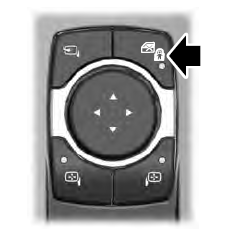
    Lincoln Aviator. Child Safety Locks

    The child safety lock control is on the driver door.

    Press the control to switch the child safety locks on. Press the control again to switch them off. A light on the child safety control illuminates when you switch them on.

    read more

     
    Copyright © 2026 www.liaviator2.com