Lincoln Aviator: Evaporative Emissions - 3.0L EcoBoost / Removal and Installation - Evaporative Emission Canister Purge Valve
Removal
.jpg) WARNING:
Do not smoke, carry lighted tobacco or have an open flame of
any type when working on or near any fuel-related component. Highly
flammable mixtures may be present and may be ignited. Failure to follow
these instructions may result in serious personal injury.
WARNING:
Do not smoke, carry lighted tobacco or have an open flame of
any type when working on or near any fuel-related component. Highly
flammable mixtures may be present and may be ignited. Failure to follow
these instructions may result in serious personal injury.
WARNING:
Do not carry personal electronic devices such as cell
phones, pagers or audio equipment of any type when working on or near
any fuel-related component. Highly flammable mixtures may be present and
may be ignited. Failure to follow these instructions may result in
serious personal injury.
NOTE: Removal steps in this procedure may contain installation details.
-
Disconnect the quick release couplings.
Refer to: Quick Release Coupling (310-00A Fuel System - General Information - 3.0L EcoBoost, General Procedures).
.jpg) |
-
-
Disconnect the electrical connector.
-
Disconnect the quick release coupling and remove the EVAP purge valve.
Refer to: Quick Release Coupling (310-00A Fuel System - General Information - 3.0L EcoBoost, General Procedures).
-
Disconnect the electrical connector.
.jpg) |
Installation
-
To install, reverse the removal procedure.
 Removal and Installation - Evaporative Emission Canister
Removal
WARNING:
Do not smoke, carry lighted tobacco or have an open flame of
any type when working on or near any fuel-related component...
 Removal and Installation - Evaporative Emission Canister Ventilation Filter
Removal
NOTE:
Removal steps in this procedure may contain installation details.
Remove the EVAP canister vent solenoid.
Refer to: Evaporative Emission Canister Vent Solenoid (303-13A Evaporative Emissions - 3...
Other information:
Lincoln Aviator 2020-2026 Service Manual: Removal and Installation - Hood
Removal NOTE: Removal steps in this procedure may contain installation details. On both sides. Index-mark the hood hinge location to aid in hood installation. Remove the clips and the hood struts. Remove the nuts and the hood...
Lincoln Aviator 2020-2026 Service Manual: General Procedures - Refrigerant Identification Testing - Vehicles With: R134A Refrigerant
Special Tool(s) / General Equipment Refrigerant Identification Equipment Activation NOTE: Use Refrigerant Identification Equipment to identify gas samples taken directly from the refrigeration system or storage containers prior to recovering or charging the refrigerant system...
Categories
- Manuals Home
- Lincoln Aviator Owners Manual
- Lincoln Aviator Service Manual
- Fuel Quality
- USB Port and Power Point Locations
- Disabling Auto-Start-Stop
- New on site
- Most important about car
Fastening the Seatbelts
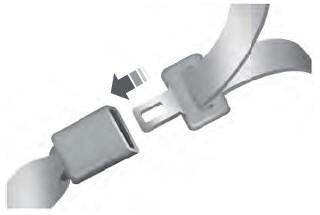
The front outboard and rear safety restraints in the vehicle are combination lap and shoulder belts.
Insert the belt tongue into the proper buckle (the buckle closest to the direction the tongue is coming from) until you hear a snap and feel it latch. Make sure that you securely fasten the tongue in the buckle.