
Lincoln Aviator: Front Disc Brake / Removal and Installation - Front Brake Flexible Hose
Removal
.jpg) WARNING:
Service actions on vehicles equipped with electronic brake
booster and electronic parking brakes may cause unexpected brake
application, which could result in injury to hands or fingers. Put the
brake system into service mode prior to servicing or removing any brake
components. Failure to follow this instruction may result in serious
personal injury.
WARNING:
Service actions on vehicles equipped with electronic brake
booster and electronic parking brakes may cause unexpected brake
application, which could result in injury to hands or fingers. Put the
brake system into service mode prior to servicing or removing any brake
components. Failure to follow this instruction may result in serious
personal injury.
NOTE: Removal steps in this procedure may contain installation details.
-
Activate the brake service mode.
Refer to: Brake Service Mode Activation and Deactivation (206-00 Brake System - General Information, General Procedures).
-
NOTICE: Make sure that all openings are sealed.
NOTICE: If the fluid is spilled on the paintwork, the affected area must be immediately washed down with cold water.
Remove the bolt and disconnect the brake hose. Discard the washers.
Torque: 26 lb.ft (35 Nm)
.jpg) |
-
Detach the wheel speed sensor wiring harness.
.jpg) |
-
-
Disconnect the brake tube fitting.
Torque: 159 lb.in (18 Nm)
-
Remove the brake hose bracket bolt.
Torque: 80 lb.in (9 Nm)
-
Remove the brake hose bracket bolt and the brake hose.
Torque: 133 lb.in (15 Nm)
-
Disconnect the brake tube fitting.
.jpg) |
Installation
-
To install, reverse the removal procedure.
-
Deactivate the brake service mode.
Refer to: Brake Service Mode Activation and Deactivation (206-00 Brake System - General Information, General Procedures).
-
Bleed the brake system.
Refer to: Brake System Pressure Bleeding (206-00 Brake System - General Information, General Procedures).
 Removal and Installation - Brake Pads
Special Tool(s) /
General Equipment
12” / 300mm C-Clamp
Removal
WARNING:
Service actions on vehicles equipped with electronic brake
booster and electronic parking brakes may cause unexpected brake
application, which could result in injury to hands or fingers...

Other information:
Lincoln Aviator 2020-2026 Service Manual: Description and Operation - Module Controlled Functions - System Operation and Component Description
System Operation BCM The BCM controls various systems by monitoring inputs from switches, sensors and network messages from other modules and components on the HS-CAN1, LIN and the GWM. Based on the inputs, the BCM activates outputs. For example, the BCM monitors the HCM inputs and provides voltage to the exterior lamps...
Lincoln Aviator 2020-2026 Service Manual: Installation - Transfer Case
Materials Name Specification Motorcraft® High Temperature 4x4 Front Axle and Wheel Bearing GreaseXG-11 WSS-M1C267-A1 NOTICE: Do not over-lubricate the driveshaft components. Using excessive grease may damage the driveshaft components...
Categories
- Manuals Home
- Lincoln Aviator Owners Manual
- Lincoln Aviator Service Manual
- Wireless Accessory Charger (If Equipped)
- Child Safety Locks
- Interior Lamps
- New on site
- Most important about car
Child Safety Locks
When the child safety locks are set, you cannot open the rear doors from the inside.
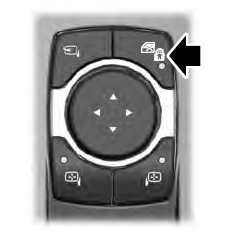
The child safety lock control is on the driver door.
Press the control to switch the child safety locks on. Press the control again to switch them off. A light on the child safety control illuminates when you switch them on.
