
Lincoln Aviator: Adaptive Cruise Control / Setting the Adaptive Cruise Control Gap
 Press the button to cycle through
the four gap settings.
Press the button to cycle through
the four gap settings.

The selected gap appears in the instrument cluster display as shown by the bars in the image.
Note: The gap setting is time dependent and therefore, the distance adjusts with your vehicle speed.
Note: It is your responsibility to select a gap appropriate to the driving conditions.
Adaptive Cruise Control Gap Settings
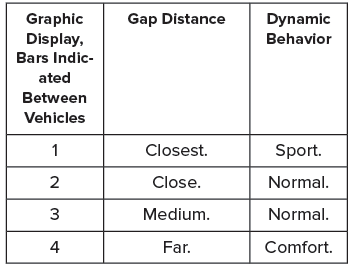
Each time you switch the system on, it selects the last chosen gap setting.
Following a Vehicle
When a vehicle ahead of you enters the same lane or a slower vehicle is ahead in the same lane, the vehicle speed adjusts to maintain the gap setting.
Note: When you are following a vehicle and you switch on a turn signal lamp, adaptive cruise control may provide a small, temporary acceleration to help you pass.
Your vehicle maintains a consistent gap from the vehicle ahead until:
- The vehicle in front of you accelerates to a speed above the set speed.
- The vehicle in front of you moves out of the lane you are in.
- You set a new gap distance.
The system applies the brakes to slow down your vehicle to maintain a safe gap distance from the vehicle in front of you. The system only applies limited braking. You can override the system by applying the brakes.
Note: The brakes may emit noise when applied by the system.
If the system determines that its maximum braking level is not sufficient, an audible warning sounds, a message appears in the instrument cluster display and an indicator flashes when the system continues to brake. Take immediate action.
 Setting the Adaptive Cruise Control Speed
Drive to the speed you prefer.
Press either button to set the
current speed.
Take your foot off the accelerator pedal.
The indicator, current gap setting and set
speed appear in the information display...
 Canceling the Set Speed. Resuming the Set Speed
Canceling the Set Speed
Press the button or tap the
brake
pedal.
The set speed does not erase.
Resuming the Set Speed
Press the button.
Your vehicle speed returns to the previously
set speed and gap setting...
Other information:
Lincoln Aviator 2020-2026 Service Manual: Removal and Installation - Steering Column Lower Shaft
Removal NOTE: Removal steps in this procedure may contain installation details. NOTICE: Do not allow the steering column to rotate while the steering column shaft is disconnected or damage to the steering column internal sensor may result...
Lincoln Aviator 2020-2026 Service Manual: General Procedures - Clockspring Adjustment
Special Tool(s) / General Equipment Adhesive Tape WARNING: If the clockspring is not correctly centralized, it may fail prematurely. If in doubt, repeat the centralizing procedure. Failure to follow these instructions may increase the risk of serious personal injury or death in a crash...
Categories
- Manuals Home
- Lincoln Aviator Owners Manual
- Lincoln Aviator Service Manual
- Description and Operation - Jacking and Lifting
- Garage Door Opener
- Description and Operation - Body and Frame
- New on site
- Most important about car
Emergency Locking
Each door has a backup power system which allows the door to function if your vehicle has no power. The system has a limited number of operations before the power is depleted and turns off. When the system turns off, the door remains open and unlatched and does not close.
If your vehicle has no power and the backup power system is turned off, you can close and secure your vehicle by manually resetting each door latch using a key in the position shown.
