
Lincoln Aviator: Rear View Camera / Using the Rear View Camera System
The rear view camera system displays what is behind your vehicle when you place the transmission in reverse (R).
Note: The reverse sensing system is not effective at speeds above 3 mph (5 km/h) and may not detect certain angular or moving objects.
The system uses three types of guides to help you see what is behind your vehicle:
- Active guidelines (if equipped): Show the intended path of your vehicle when reversing.
- Fixed guidelines: Show the actual path your vehicle is moving in while reversing in a straight line. This can be helpful when backing into a parking space or aligning your vehicle with another object behind you.
- Centerline: Helps align the center of your vehicle with an object (for example, a trailer).
Note: If the transmission is in reverse (R) and the luggage compartment door is open, no rear view camera features display.
Note: When towing, the camera only sees what you are towing. This might not provide adequate coverage as it usually provides in normal operation and some objects might not be seen. In some vehicles, the guidelines may disappear when you connect the trailer tow connector.
The camera may not operate correctly under the following conditions:
- Nighttime or dark areas if one or both reverse lamps are not operating.
- Mud, water or debris obstructs the camera's view. Clean the lens with a soft, lint-free cloth and non-abrasive cleaner. You can also use the rear washer to clean the camera.
- The rear of your vehicle is hit or damaged, causing the camera to become misaligned.
Camera System Settings
Depending on your vehicle options, the rear view camera system settings may be in the following:
- Information display.
- Touchscreen.
Note: Active guidelines are only available when the transmission is in reverse (R).
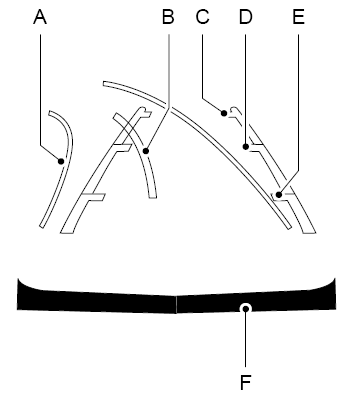
- Active guidelines (If equipped)
- Centerline
- Fixed guideline: Green zone
- Fixed guideline: Yellow zone
- Fixed guideline: Red zone
- Rear bumper
Active guidelines are only shown with fixed guidelines. To use active guidelines, turn the steering wheel to point the guidelines toward an intended path. If you change the steering wheel position while reversing, your vehicle might deviate from the original intended path.
The fixed and active guidelines fade in and out depending on the steering wheel position. The active guidelines do not display when the steering wheel position is straight.
Always use caution while reversing. Objects in the red zone are closest to your vehicle and objects in the green zone are farther away. Objects are getting closer to your vehicle as they move from the green zone to the yellow or red zones. Use the side view mirrors and rear view mirror to get better coverage on both sides and rear of the vehicle.
 Rear View Camera
WARNING: The rear view camera
system is a reverse aid supplement device
that still requires the driver to use it in
conjunction with the interior and exterior
mirrors for maximum coverage...
 Object Distance Indicator (If Equipped)
The system provides an image of your
vehicle and the sensor zones. The zones
highlight green, yellow and red when the
parking aid sensors detect an object in the
coverage area...
Other information:
Lincoln Aviator 2020-2026 Service Manual: Removal and Installation - Tie Rod End
Special Tool(s) / General Equipment Tie Rod End Remover Removal NOTE: Removal steps in this procedure may contain installation details. Remove the wheel and tire. Refer to: Wheel and Tire (204-04A Wheels and Tires, Removal and Installation)...
Lincoln Aviator 2020-2026 Service Manual: Removal and Installation - Shock Absorber and Spring Assembly
Removal NOTICE: Suspension fasteners are critical parts that affect the performance of vital components and systems. Failure of these fasteners may result in major service expense. Use the same or equivalent parts if replacement is necessary. Do not use a replacement part of lesser quality or substitute design...
Categories
- Manuals Home
- Lincoln Aviator Owners Manual
- Lincoln Aviator Service Manual
- Child Safety Locks
- Keyless Entry
- Garage Door Opener
- New on site
- Most important about car
Child Safety Locks
When the child safety locks are set, you cannot open the rear doors from the inside.
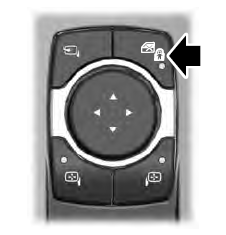
The child safety lock control is on the driver door.
Press the control to switch the child safety locks on. Press the control again to switch them off. A light on the child safety control illuminates when you switch them on.
