Lincoln Aviator: Battery, Mounting and Cables / Description and Operation - Battery and Cables - System Operation and Component Description
System Operation
Gasoline Vehicles
The main battery, which is located in the engine compartment, is a 12 volt DC source connected in a negative ground system and is a voltage stabilizer for the 12 volt electrical system.
A BMS
is attached to the negative side of the battery cable and a generator
current sensor (if equipped) is attached to the positive side of the
battery cable. For description of these components,
Refer to: Charging System - System Operation and Component Description (414-00 Charging System - General Information, Description and Operation).
Hybrid Vehicles
Hybrid
vehicles utilize the main engine compartment battery and an additional
8Ah auxiliary battery. Just like the gasoline vehicles, the main engine
compartment battery has a BMS
that is attached to the negative side of the battery cable. The
auxiliary battery provides support for transient electrical loads that
occur during a crank event when the main engine compartment battery is
isolated from the rest of the vehicle and unable to provide transient
support. The auxiliary battery transient support is only needed if the
DC/DC 12 volt output is at or near full capacity (220A). The auxiliary
battery is located in the rear compartment, on the LH side of the vehicle. An auxiliary battery isolator, which is located above the main engine compartment battery, uses a LIN to supply diagnostics to the PCM. The auxiliary battery isolator receives a PWM signal from the PCM commanding the auxiliary battery isolator to open and close. During a cranking event the PCM
request the auxiliary battery isolator to open, disconnecting the
cranking main engine compartment battery, starter, and starter generator
from the 12 volt bus. The rest of the vehicle's electrical architecture
does not detect the low-voltage transient caused by engine cranking. A
battery current sensor is attached to the auxiliary battery negative
battery cable. For description of these components,
Refer to: Charging System - System Operation and Component Description (414-00 Charging System - General Information, Description and Operation).
All Vehicles
Ford Motor Company strongly recommends that all faulty batteries be returned to an authorized recycling facility for disposal.

 Diagnosis and Testing - Battery
General Equipment
Diagnostic Battery Charger
Use Ford approved battery test equipment.
Midtronics MDX-650 or P-300/P-600/490/1050
Midtronics GRX-3590 or 3000
Diagnostics in this manual assume a certain skill level and knowledge of Ford-specific diagnostic practices...
Other information:
Lincoln Aviator 2020-2026 Owners Manual: Child Restraint and Seatbelt Maintenance
Inspect the vehicle seatbelts and child safety seat systems periodically to make sure they work properly and are not damaged. Inspect the vehicle and child restraint seatbelts to make sure there are no nicks, tears or cuts. Replace if necessary. All vehicle seatbelt assemblies, including retractors, buckles, front seatbelt buckle assemblies, buckle support assemblies (slide bar-if equipped), shoulder belt height adjusters (if equipped), shoulder belt guide on seat backrest (if equipped), child safety seat LATCH and tether anchors, and attaching hardware, should be inspected after a crash...
Lincoln Aviator 2020-2026 Owners Manual: Activating Intelligent Access
The intelligent access key must be within 3 ft (1 m) of the door or luggage compartment you intend to lock or unlock. At a Door Electronic door handles are on each door. Gently depress the switch inside the exterior door handle to unlock and open the door...
Categories
- Manuals Home
- Lincoln Aviator Owners Manual
- Lincoln Aviator Service Manual
- Garage Door Opener
- General Procedures - Transmission Fluid Drain and Refill
- Tire Change Procedure
- New on site
- Most important about car
Fastening the Seatbelts
The front outboard and rear safety restraints in the vehicle are combination lap and shoulder belts.
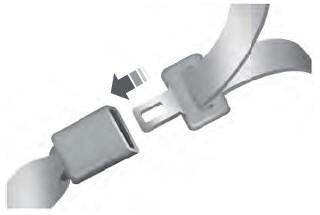
Insert the belt tongue into the proper buckle (the buckle closest to the direction the tongue is coming from) until you hear a snap and feel it latch. Make sure that you securely fasten the tongue in the buckle.