Lincoln Aviator: Accessory Charging / Description and Operation - Wireless Accessory Charging Module (WACM) - Overview
The WACM is a 5 watt wireless power transmitter designed to energize a secondary coil found in a secondary device such as a smartphone or in an added accessory such as a wireless charging phone sleeve. The WACM supports wireless charging of the Wireless Power Consortium’s (WPC) Qi (pronounced chee).
The WACM node is powered at all times from a fused battery and performs network management on HS-CAN3. Wireless charging status is provided as a CAN signal on the HS-CAN3.
The BCM provides a protected switch to battery input to the WACM when an interior passive key search is in progress to disable the wireless charging feature. This prevents possible interference with the passive key when placed in close proximity to the WACM during a charge session of a secondary device. A redundant CAN signal is also sent by the BCM in addition to the protected switch to battery input.

 Description and Operation - Wireless Accessory Charging Module (WACM) - System Operation and Component Description
System Operation
System Diagram
Item
Description
1
APIM
2
BCM
3
ACM
4
WACM
5
GWM
Network Message Chart
APIM Module Network Input Messages
Broadcast Message
Originating Module
Message Purpose
WACM send signals
WACM
Contains the status of the WACM charging input to be used for FCIM display...
Other information:
Lincoln Aviator 2020-2026 Service Manual: Description and Operation - Body Closures - System Operation and Component Description
System Operation System Diagram Item Description 1 RGTM 2 Front Power Liftgate Switch 3 Exterior Liftgate Release Switch 4 Anti-Pinch Switches 5 BCM 6 Left/Right Power Liftgate Motors 7 Power Liftgate Latch 8 Cinch Motor 9 Latch/Cinch Switches 10 Hands-Free Liftgate Actuation Module 11 Hands-Free Liftgate Actuation Sensors 12 Rear Interior Power Liftgate Switch 13 GWM 14 IPC 15 GWM 16 ACM 17 Release Motor 18 Motor 19 Position Sensor Network Message Chart RGTM Network Input Messages Broadcast Message Originating Module Message Purpose Liftgate request BCM Used by the RGTM to open/close the liftgate when the BCM receives a valid request from a programmed RKE transmitter or the passive entry feature...
Lincoln Aviator 2020-2026 Owners Manual: How Temperature Affects Your Tire Pressure
The tire pressure monitoring system monitors tire pressure in each pneumatic tire. While driving in a normal manner, a typical passenger tire inflation pressure may increase about 2–4 psi (14–28 kPa) from a cold start situation. If the vehicle is stationary overnight with the outside temperature significantly lower than the daytime temperature, the tire pressure may decrease about 3 psi (21 kPa) for a drop of 30°F (17°C) in ambient temperature...
Categories
- Manuals Home
- Lincoln Aviator Owners Manual
- Lincoln Aviator Service Manual
- Drive Modes
- Wireless Accessory Charger (If Equipped)
- Fuel Quality
- New on site
- Most important about car
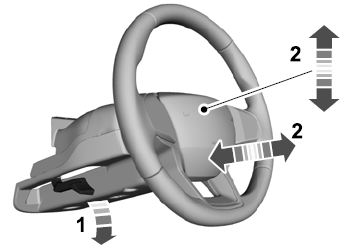
Adjusting the Steering Wheel - Vehicles With: Manual Adjustable Steering Column
WARNING: Do not adjust the steering wheel when your vehicle is moving.
Note: Make sure that you are sitting in the correct position.
Unlock the steering column. Adjust the steering wheel to the desired position.