Lincoln Aviator: Wipers and Washers / General Procedures - Washer Hose Coupling
Disconnect
-
Refer to: Health and Safety Precautions (100-00 General Information, Description and Operation)..jpg) WARNING:
Before beginning any service procedure in this
section, refer to Safety Warnings in section 100-00 General Information.
Failure to follow this instruction may result in serious personal
injury.
WARNING:
Before beginning any service procedure in this
section, refer to Safety Warnings in section 100-00 General Information.
Failure to follow this instruction may result in serious personal
injury.
-
NOTICE: To prevent damage to the coupler, do not use hand tools to disconnect /connect the C-lock.
NOTE: Do not remove the lock ring from the C-lock coupler.
NOTE: Hold the female side of the coupler at the hose connection to prevent the coupler from rotating internally.
Gently twist the lock ring until it has rotated approximately 90 degrees.
.jpg) |
-
NOTICE: The female side of the C-lock coupler contains an o-ring seal. Use care not to lose the o-ring.
Slide the C-lock coupler apart from the component fitting.
.jpg) |
-
NOTICE: Do not leave the lock ring in the unlocked position. This will weaken the lock ring and prevent it from correctly locking in place when reassembled, resulting in a leak.
Rotate the lock ring back to the original locked position.
.jpg) |
-
To connect, verify the C-lock coupler lock ring is in the locked position.
-
NOTE: The lock ring flexes open slightly to allow the male fitting to enter the C-lock coupler.
NOTE: The lock ring can be heard as it snaps into the lock position.
Insert the male fitting into the C-lock coupler.
-
Gently pull on the C-lock coupler to verify it is seated correctly.
 Diagnosis and Testing - Wipers and Washers
Diagnostic Trouble Code (DTC) Chart
Diagnostics in this manual assume a certain skill level and knowledge of Ford-specific diagnostic practices. REFER to: Diagnostic Methods (100-00 General Information, Description and Operation)...
 General Procedures - Washer Hose Repair
Repair
NOTE:
This procedure may be carried out on rubber hoses only. If a
plastic washer hose is damaged, a new washer hose must be installed.
Locate and verify the damaged washer hose...
Other information:
Lincoln Aviator 2020-2026 Service Manual: General Procedures - Tire Pressure Monitoring System (TPMS) Sensor Location Calibration
Special Tool(s) / General Equipment 204-D081A (204-D081) Tire Pressure Monitor (TPMS) Ford Diagnostic Equipment Programming NOTE: The TPMS can be placed into learn mode using a diagnostic scan tool or manually where a diagnostic scan tool is not available...
Lincoln Aviator 2020-2026 Service Manual: Description and Operation - Third Row Seats - Overview
Overview Third Row Power Fold Seats Pressing and releasing the power fold seat control switch (located in the rear cargo area on the RH loadspace trim panel) causes the corresponding third row seat backrest(s) to fold forward for additional cargo space...
Categories
- Manuals Home
- Lincoln Aviator Owners Manual
- Lincoln Aviator Service Manual
- Child Safety Locks
- Fuel Quality
- General Procedures - Transmission Fluid Drain and Refill
- New on site
- Most important about car
Children and Airbags
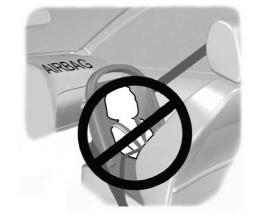
WARNING: Airbags can kill or injure a child in a child restraint. Never place a rear-facing child restraint in front of an active airbag. If you must use a forward-facing child restraint in the front seat, move the seat upon which the child restraint is installed all the way back.