
Lincoln Aviator: Capacities and Specifications - Plug-In Hybrid Electric Vehicle (PHEV) / Hydraulic Brake System
Materials

Note: We recommend using DOT 4 Low Viscosity (LV) High Performance Brake Fluid or equivalent meeting WSS-M6C65-A2. Use of any fluid other than the recommended fluid could cause reduced brake performance and not meet our performance standards. Keep brake fluid clean and dry. Contamination with dirt, water, petroleum products or other materials could result in brake system damage and possible failure.
 Grease
M..
 Locks
Locks
M..
Other information:
Lincoln Aviator 2020-2026 Service Manual: Removal and Installation - Charge Air Cooler (CAC) Outlet Pipe
Removal NOTICE: The turbocharger compressor vanes can be damaged by even the smallest particles. When removing any turbocharger or engine air intake system component, ensure that no debris enters the system. Failure to do so may result in damage to the turbocharger...
Lincoln Aviator 2020-2026 Service Manual: Removal and Installation - Remote Keyless Entry (RKE) Exterior Sounder
Removal Remove the air cleaner intake pipe. Refer to: Air Cleaner Intake Pipe (303-12 Intake Air Distribution and Filtering - 3.0L EcoBoost/3.0L EcoBoost – Hybrid (BQ), Removal and Installation). Remove the CAC outlet pipe. Refer to: Charge Air Cooler (CAC) Outlet Pipe (303-12 Intake Air Distribution and Filtering - 3...
Categories
- Manuals Home
- Lincoln Aviator Owners Manual
- Lincoln Aviator Service Manual
- USB Port and Power Point Locations
- Wireless Accessory Charger (If Equipped)
- Description and Operation - Body and Frame
- New on site
- Most important about car
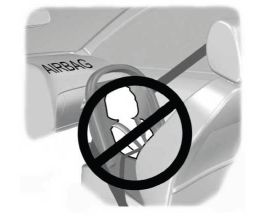
Children and Airbags
WARNING: Airbags can kill or injure a child in a child restraint. Never place a rear-facing child restraint in front of an active airbag. If you must use a forward-facing child restraint in the front seat, move the seat upon which the child restraint is installed all the way back.

Copyright © 2026 www.liaviator2.com