
Lincoln Aviator: Interior Trim and Ornamentation / Removal and Installation - B-Pillar Trim Panel
Special Tool(s) / General Equipment
| Interior Trim Remover |
Removal
NOTE: LH (left hand) shown, RH (right hand) similar.
Upper and lower B-pillar trim panels
-
Remove the following items:
-
Remove the front scuff plate trim panel.
Refer to: Front Scuff Plate Trim Panel (501-05 Interior Trim and Ornamentation, Removal and Installation).
-
Remove the rear scuff plate trim panel.
Refer to: Rear Scuff Plate Trim Panel (501-05 Interior Trim and Ornamentation, Removal and Installation).
-
Remove the front scuff plate trim panel.
-
Position the front seat in the full forward position.
.jpg) |
-
NOTE: Seats removed for clarity.
Release the tabs and remove the lower B-pillar trim panel cover.
Use the General Equipment: Interior Trim Remover
.jpg) |
-
NOTE: Seats removed for clarity.
Release the clips and remove the lower B-pillar trim panel. .
Use the General Equipment: Interior Trim Remover
.jpg) |
Upper B-pillar trim panel
.jpg) WARNING:
The following procedure prescribes critical repair steps
required for correct restraint system operation during a crash. Follow
all notes and steps carefully. Failure to follow step instructions may
result in incorrect operation of the restraint system and increases the
risk of serious personal injury or death in a crash.
WARNING:
The following procedure prescribes critical repair steps
required for correct restraint system operation during a crash. Follow
all notes and steps carefully. Failure to follow step instructions may
result in incorrect operation of the restraint system and increases the
risk of serious personal injury or death in a crash.
NOTE: Removal steps in this procedure may contain installation details.
-
Refer to: Pyrotechnic Device Health and Safety Precautions (100-00 General Information, Description and Operation).
WARNING:
Before beginning any service procedure in this
manual, refer to health and safety warnings in section 100-00 General
Information. Failure to follow this instruction may result in serious
personal injury.
-
Depower the SRS.
Refer to: Supplemental Restraint System (SRS) Depowering (501-20B Supplemental Restraint System, General Procedures).
-
NOTE: Seats removed for clarity.
Disconnect the front seatbelt retractor and pretensioner electrical connector.
.jpg) |
-
NOTE: Seats removed for clarity.
Remove the front seatbelt retractor and pretenioner anchor nut.
Torque: 35 lb.ft (47 Nm)
.jpg) |
-
Remove the upper B-pillar trim panel bolt.
Torque: 80 lb.in (9 Nm)
.jpg) |
-
Remove the upper B-pillar trim panel.
-
Release the upper B-pillar trim panel lower clip.
Use the General Equipment: Interior Trim Remover
-
Pull downward and outward on the upper B-pillar trim panel releasing the upper tabs.
-
Feed the front seatbelt retractor and pretenioner through the opening in the upper B-pillar trim panel.
-
Release the upper B-pillar trim panel lower clip.
.jpg) |
Installation
NOTE: During installation, make sure the seatbelt webbing is not twisted and the seatbelts and buckles are acccessible to the occupants.
-
To install, reverse the removal procedure.
-
Inspect and position the front door and rear door
weather strip lips so that they overlap the top of the B-pillar trim
panels.
.jpg) |
-
Repower the SRS.
Refer to: Supplemental Restraint System (SRS) Repowering (501-20B Supplemental Restraint System, General Procedures).
-
Check the seatbelt system for correct operation.
Refer to: Seatbelt Systems (501-20A Seatbelt Systems, Diagnosis and Testing).
 Removal and Installation - A-Pillar Trim Panel
Special Tool(s) /
General Equipment
Interior Trim Remover
Removal
NOTE:
LH (left hand) shown, RH (right hand) similar.
Release the clips and remove the instrument panel side trim panel...
 Removal and Installation - C-Pillar Trim Panel
Special Tool(s) /
General Equipment
Interior Trim Remover
Removal
NOTE:
LH (left hand) shown, RH (right hand) similar.
NOTE:
Removal steps in this procedure may contain installation details...
Other information:
Lincoln Aviator 2020-2026 Owners Manual: Side Airbags and Driver and Passenger Knee Airbags
Side Airbags WARNING: Do not place objects or mount equipment on or near the airbag cover, on the side of the front or rear seatbacks, or in areas that may come into contact with a deploying airbag. Failure to follow these instructions may increase the risk of personal injury in the event of a crash...
Lincoln Aviator 2020-2026 Service Manual: Description and Operation - Power Brake System - Overview
Electric Brake Boost Overview The power assisted brake system utilizes an EBB. The EBB is an integrated function of the ABS / HCU assembly and is controlled by the ABS module. The ABS/ HCU combines the functions of a conventional vacuum booster and ABS module...
Categories
- Manuals Home
- Lincoln Aviator Owners Manual
- Lincoln Aviator Service Manual
- Fuel Quality
- Wireless Accessory Charger (If Equipped)
- Tire Change Procedure
- New on site
- Most important about car
Remote Control
Passive Key
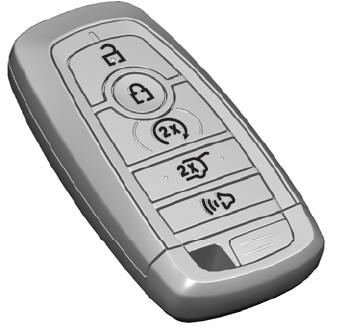
The passive key operates the power locks and the remote start system. The passive key must be in your vehicle to use the push button start.
Note: You may not be able to shift out of park (P) unless the passive key is inside your vehicle.
