
Lincoln Aviator 2020-2026 Service Manual / Body and Paint / Body and Paint / Body Closures / Removal and Installation - Power Liftgate Motor
Lincoln Aviator: Body Closures / Removal and Installation - Power Liftgate Motor
Removal
NOTE: Removal steps in this procedure may contain installation details.
NOTE: LH side shown, RH side similar
-
Remove the LH D-pillar trim panel.
Refer to: D-Pillar Trim Panel (501-05 Interior Trim and Ornamentation, Removal and Installation).
-
Disconnect the power liftgate motor electrical connector.
.jpg) |
-
-
Remove the retainer.
-
Gently pull and remove the drip moulding cover.
-
Remove the retainer.
.jpg) |
-
Route the power liftgate motor electrical harness through the body.
.jpg) |
-
NOTICE: Support the liftgate before removing the power liftgate motor. Failure to follow this direction may result in damage to the components.
NOTE: This step requires the aid of another technician.
Remove the clips and the power liftgate motor.
.jpg) |
Installation
- To install, reverse the removal procedure.
-
Carry-out the power liftgate initialization.
Refer to: Power Liftgate Initialization (501-03 Body Closures, General Procedures).
 Removal and Installation - Liftgate Anti-Pinch Switch
Removal
NOTE:
Removal steps in this procedure may contain installation details.
NOTE:
LH side shown, RH side similar.
Remove the liftgate trim panel...
 Removal and Installation - Rear Door
Removal
NOTE:
Removal steps in this procedure may contain installation details.
NOTE:
LH side shown, RH side similar.
Open the door...
Other information:
Lincoln Aviator 2020-2026 Service Manual: Diagnosis and Testing - Cruise Control - Vehicles With: Adaptive Cruise Control With Lane Centering
Diagnostic Trouble Code (DTC) Chart Diagnostics in this manual assume a certain skill level and knowledge of Ford-specific diagnostic practices. REFER to: Diagnostic Methods (100-00 General Information, Description and Operation). Diagnostic Trouble Code Chart Module DTC Description Action CCM B142E:78 Forward Looking Sensor Horizontal Alignment: Alignment or Adjustment Incorrect GO to Pinpoint Test C CCM B1433:54 Forward Looking Sensor Horizontal Alignment: Missing Calibration GO to Pinpoint Test C CCM C1001:08 Vision System Camera: Bus Signal/Message Failure GO to Pinpoint Test D CCM C1A67:96 Forward Looking Sensor: Component Internal Failure GO to Pinpoint Test F CCM C1A67:97 Forward Looking Sensor: Component Or System Operation Obstructed Or Blocked GO to Pinpoint Test G CCM U2100:00 Initial Configuration Not Complete: No Sub Type Information GO to Pinpoint Test H CCM U2300:55 Central Configuration Not Complete: No Sub Type Information GO to Pinpoint Test H CCM U3000:41 Control Module: General Checksum Failure GO to Pinpoint Test I CCM U3000:42 Control Module: General Memory Failure GO to Pinpoint Test I CCM U3000:44 Control Module: Data Memory Failure GO to Pinpoint Test I CCM U3000:49 Control Module: Internal Electronic Failure GO to Pinpoint Test I CCM U3002:62 Vehicle Identification Number: Signal Compare Failure GO to Pinpoint Test J CCM U3003:16 Battery Voltage: Circuit Voltage Below Threshold GO to Pinpoint Test K CCM U3003:17 Battery Voltage: Circuit Voltage Above Threshold GO to Pinpoint Test L IPMA C1A67:08 Forward Looking Sensor: Bus Signal/Message Failure GO to Pinpoint Test E PCM P0504:00 Brake Switch A / B Correlation: No Sub Type Information GO to Pinpoint Test B PCM P0572:00 Brake Switch "A" Circuit Low: No Sub Type Information GO to Pinpoint Test B PCM P0573:00 Brake Switch "A" Circuit High: No Sub Type Information GO to Pinpoint Test B PCM P1703:00 Brake Switch Out Of Self - Test Range: No Sub Type Information GO to Pinpoint Test B PCM P1935:00 Brake Switch/Sensor Signal: No Sub Type Information GO to Pinpoint Test B SIMA P0564:11 Cruise Control Multi-Function Input "A" Circuit: Circuit Short To Ground GO to Pinpoint Test A SIMA P0564:12 Cruise Control Mulit-Function Input "A" Circuit: Circuit Short To Battery GO to Pinpoint Test A SIMA P0564:13 Cruise Control Mulit-Function Input "A" Circuit: Circuit Open GO to Pinpoint Test A SIMA P0589:11 Cruise Control Multi-Function Input "B" Circuit: Circuit Short To Ground GO to Pinpoint Test A SIMA P0589:12 Cruise Control Mulit-Function Input "B" Circuit: Circuit Short To Battery GO to Pinpoint Test A SIMA P0589:13 Cruise Control Mulit-Function Input "B" Circuit: Circuit Open GO to Pinpoint Test A Global Customer Symptom Code (GCSC) Chart Diagnostics in this manual assume a certain skill level and knowledge of Ford-specific diagnostic practices...
Lincoln Aviator 2020-2026 Service Manual: General Procedures - Door Latch Lubrication
Special Tool(s) / General Equipment Flat-Bladed Screwdriver Materials Name Specification Motorcraft® Multi-Purpose Grease SprayXL-5-A ESB-M1C93-B Activation NOTE: Typical left front door shown, others similar. Open the door...
Categories
- Manuals Home
- Lincoln Aviator Owners Manual
- Lincoln Aviator Service Manual
- Changing the Front Wiper Blades - Vehicles With: Heated Wiper Blades
- Drive Modes
- Remove and Reinstall the Battery
- New on site
- Most important about car
Adjusting the Steering Wheel - Vehicles With: Manual Adjustable Steering Column
WARNING: Do not adjust the steering wheel when your vehicle is moving.
Note: Make sure that you are sitting in the correct position.
Unlock the steering column. Adjust the steering wheel to the desired position.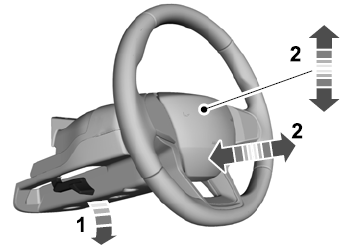

Copyright © 2026 www.liaviator2.com