Lincoln Aviator: SYNC™ 3 / Apps
The system allows you interact with select mobile apps while keeping your eyes on the road. Voice commands, your steering wheel buttons, or a quick tap on your touchscreen give you advanced control of compatible mobile apps. You can also stream your favorite music or podcasts, share your time of arrival with friends, and keep connected safely.
When you start an app through the system for the first time, you could be asked to grant certain permissions. You can review and change the permissions that you have granted at any time when your vehicle is not moving. We recommend that you check your data plan before using your apps through the system. Using them could result in additional charges. We also recommend that you check the app provider's terms and conditions and privacy policy before using their app. Make sure that you have an active account for apps that you want to use through the system. Some apps will work with no setup. Others require you to configure some personal settings before you can use them.
Note: For more information about available apps, visit catalog.ford.com.
- Using Apps on an iOS Device
- Using Apps on an Android Device
- Using Mobile Navigation on an Android Device
- SiriusXM Traffic and Travel Link (If Equipped)
 Departure Time Settings
Select Charge Preferences on the
Charge Settings screen.
Select Departure Time Setup on the Edit
Charge Preferences screen.
Two time settings show for each day of
the week on the Departure Times
schedule screen...
 Using Apps on an iOS Device
Select the apps option on the
feature bar.
If your device is connected via USB,
switch Apple CarPlay off.
Connect your device to a USB port or
pair and connect using Bluetooth...
Other information:
Lincoln Aviator 2020-2026 Service Manual: Description and Operation - Main Control Valve Body
Item Description 1 Internal wiring harness retaining bolt 2 Internal wiring harness 3 Park lock pawl solenoid 4 Solenoid retaining plate bolts 5 Solenoid retaining plate 6 TCC solenoid 7 LPC solenoid 8 Shift solenoid retaining plate bolts 9 Shift solenoid retaining plate 10 SSD 11 SSE 12 SSB 13 SSC 14 SSF 15 SSA 16 TFT 17 Valve channel plate bolts 18 Valve channel plate 19 Lower-to-upper valve body bolts 20 Lower valve body 21 Upper valve body 22 Valve body dowel pins Lower Valve Body 1 Valve body separator plate bolts 2 Valve body separator plate 3 TCC damper 4 LPC damper assembly 5 Check valve assemblies 6 Check balls (quantity 5) 7 LPC anti-backflow valve assembly 8 TCC priority valve assembly 9 Park lock pawl valve 10 A clutch control valve 11 SSA 12 F clutch control valve 13 SSF 14 C clutch control valve 15 SSC 16 B clutch control valve 17 SSB 18 E clutch control valve 19 SSE 20 D clutch control valve 21 SSD 22 Shift solenoid retainers Upper Valve Body 1 Lube control valve assembly 2 Plug and spring assembly 3 C clutch latch valve assembly 4 B clutch latch valve assembly 5 F clutch latch valve assembly 6 A clutch latch valve assembly 7 Plug and spring assembly 8 TCC regulator valve assembly 9 Main regulator valve assembly The main control consists of a upper and lower valve body with solenoids that are controlled by a remote mounted TCM or the PCM...
Lincoln Aviator 2020-2026 Service Manual: Description and Operation - Parking Aid - Overview
Overview Rear Only Parking Aid Camera The rear parking aid camera system visually aids the driver while reversing or reverse parking the vehicle. The camera system has features that provide fixed and active guideline overlays on the video image to assist the driver in aligning the vehicle and a visual alert function that provides a visual highlight in the zone where an object is detected by the audible parking aid system...
Categories
- Manuals Home
- Lincoln Aviator Owners Manual
- Lincoln Aviator Service Manual
- Remove and Reinstall the Battery
- Child Safety Locks
- Keyless Entry
- New on site
- Most important about car
Fastening the Seatbelts
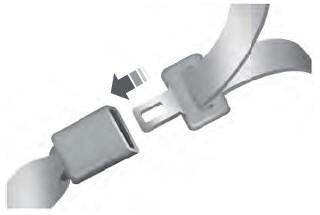
The front outboard and rear safety restraints in the vehicle are combination lap and shoulder belts.
Insert the belt tongue into the proper buckle (the buckle closest to the direction the tongue is coming from) until you hear a snap and feel it latch. Make sure that you securely fasten the tongue in the buckle.