
Lincoln Aviator: Cruise Control

What Is Cruise Control

Cruise control lets you maintain a set speed without keeping your foot on the accelerator pedal.

Requirements

Use cruise control when the vehicle speed is greater than 20 mph (30 km/h).  

Front Camera. Side Camera

Front Camera WARNING: The front camera system still requires the driver to use it in conjunction with looking out of your vehicle. Note: The system turns off the front video image when your vehicle is in motion at low speed, except when in reverse (R)...

Switching Cruise Control On and Off

WARNING: Do not use cruise control on winding roads, in heavy traffic or when the road surface is slippery. This could result in loss of vehicle control, serious injury or death...

Other information:

Lincoln Aviator 2020-2026 Service Manual: Description and Operation - Passive Anti-Theft System (PATS) - Overview


Overview The PATS deters the vehicle from theft by preventing the vehicle from starting unless a valid programmed key is detected inside the vehicle when the START/STOP button is pressed. The PATS does not disable an already running vehicle. Backup Starting NOTE: There are certain areas within the vehicle where the passive key may not be detected and the message center displays No Key Detected...

Lincoln Aviator 2020-2026 Service Manual: Diagnosis and Testing - Fuel Tank and Lines


Diagnostic Trouble Code (DTC) Chart Diagnostics in this manual assume a certain skill level and knowledge of Ford-specific diagnostic practices.REFER to: Diagnostic Methods (100-00 General Information, Description and Operation).   Diagnostic Trouble Code Chart Module   DTC Description Action   PCM P008A:00 Low Pressure Fuel System Pressure - Too Low: No Sub Type Information   GO to Pinpoint Test HC   PCM P008B:00 Low Pressure Fuel System Pressure - Too High: No Sub Type Information   GO to Pinpoint Test HC   PCM P00BA:00 Low Fuel Pressure - Forced Limited Power: No Sub Type Information   GO to Pinpoint Test HC   PCM P00BB:00 Fuel Injector Insufficient Flow - Forced Limited Power: No Sub Type Information   GO to Pinpoint Test HC   PCM P0148:00 Fuel Delivery Error: No Sub Type Information   GO to Pinpoint Test HC   PCM P0230:00 Fuel Pump Primary Circuit: No Sub Type Information   GO to Pinpoint Test KC   PCM P0231:00 Fuel Pump Secondary Circuit Low: No Sub Type Information   GO to Pinpoint Test KC   PCM P0232:00 Fuel Pump Secondary Circuit High: No Sub Type Information   GO to Pinpoint Test KC   PCM P025A:00 Fuel Pump Module A Control Circuit/Open: No Sub Type Information   GO to Pinpoint Test KC   PCM P025B:00 Fuel Pump Module A Control Circuit Range/Performance: No Sub Type Information   GO to Pinpoint Test KC   PCM P025C:00 Fuel Pump Module A Control Circuit Low: No Sub Type Information   GO to Pinpoint Test KC   PCM P025D:00 Fuel Pump Module A Control Circuit High: No Sub Type Information   GO to Pinpoint Test KC   PCM P027B:00 Fuel Pump Module B Control Circuit Range/Performance: No Sub Type Information   GO to Pinpoint Test KC   PCM P0627:00 Fuel Pump A Control Circuit/Open: No Sub Type Information   GO to Pinpoint Test KC   PCM P064A:00 Fuel Pump Control Module A: No Sub Type Information   GO to Pinpoint Test KC   PCM P166A:00 Restraints Deployment Communication Circuit: No Sub Type Information   GO to Pinpoint Test KC   PCM P2632:00 Fuel Pump B Control Circuit/Open: No Sub Type Information   GO to Pinpoint Test KC   PCM P26EA:00 Fuel Pump Control Module B: No Sub Type Information   GO to Pinpoint Test KC   PCM U0109:00 Lost Communication With Fuel Pump Control Module A: No Sub Type Information   GO to Pinpoint Test KC   PCM U016C:00 Lost Communication With Fuel Pump Control Module B: No Sub Type Information   GO to Pinpoint Test KC   PCM U210B:00 Lost Communication Between Fuel Pump Control Module A And Restraints Control Module: No Sub Type Information   GO to Pinpoint Test KC Global Customer Symptom Code (GCSC) Chart Diagnostics in this manual assume a certain skill level and knowledge of Ford-specific diagnostic practices...

Categories

Children and Airbags

WARNING: Airbags can kill or injure a child in a child restraint. Never place a rear-facing child restraint in front of an active airbag. If you must use a forward-facing child restraint in the front seat, move the seat upon which the child restraint is installed all the way back.
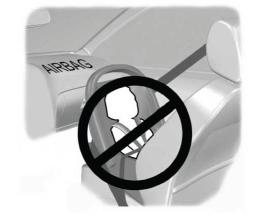
Lincoln Aviator. Children and Airbags

read more

 
Copyright © 2026 www.liaviator2.com