
Lincoln Aviator: Body Repairs - Vehicle Specific Information and Tolerance Checks / General Procedures - Body Panel Sectioning
Special Tool(s) / General Equipment
| Resistance Spotwelding Equipment | |
| Spherical Cutter | |
| Air Body Saw | |
| MIG/MAG Welding Equipment | |
| Locking Pliers |
Materials
| Name | Specification |
|---|---|
| Seam Sealer TA-2-B, 3M™ 08308, LORD Fusor® 803DTM |
- |
Repair
NOTICE: Do not carry out body side sectioning repairs in areas of door hinge, safety restraints or striker anchoring points. Welding within 50 mm (1.96 in) of door hinge or striker locations may compromise structural integrity during a collision.
NOTICE: Sectioning within 50mm of the door hinge portion of the A-pillar, B-pillar or dog leg portion is not approved by Ford Motor Company.
NOTE: Do not begin removal of the vehicle body side until the replacement panel is available for reference.
NOTE: LH side shown, RH side similar.
NOTE: The following illustration is intended as a general guideline for body side and door opening panels (DOP) and is not all inclusive.
.jpg) |
-
Restore the vehicle dimensionally to pre-damage condition.
Refer to: Body and Frame (501-26 Body Repairs - Vehicle Specific Information and Tolerance Checks, Description and Operation).
-
As a general rule, sectioning cut points should be chosen to result in the smallest repair area possible.
Refer to: Vehicle Specific Body Construction (501-26 Body Repairs - Vehicle Specific Information and Tolerance Checks, Description and Operation).
-
Detrim the vehicle as necessary in the area to be repaired.
-
Only remove as much of the outer body side as necessary.
Use the General Equipment: Air Body Saw
Use the General Equipment: Spherical Cutter
-
Where possible, create a lap-joint backer plate from an
unused portion of the old or replacement panel. This will create a
stronger joint.
Refer to: Joining Techniques (501-25 Body Repairs - General Information, General Procedures).
Use the General Equipment: MIG/MAG Welding Equipment
Use the General Equipment: Resistance Spotwelding Equipment
Use the General Equipment: Locking Pliers
-
Rough finish all sectioning joints with a fibre-based
body filler, final finish sectioning joints and plug welds with a
conventional body filler.
-
Properly seal all joints to prevent moisture intrusion.
Water and moisture migrate toward horizontal joints and corrosion tends
to occur more rapidly in these areas.
Material: Seam Sealer / TA-2-B, 3M™ 08308, LORD Fusor® 803DTM
-
NOTICE: The HVTB (High Voltage Traction Battery) in an EV (Electric Vehicle), HEVor PHEVcan be affected and damaged by excessively high temperatures. The temperature in some body shop paint booths can exceed 60°C (140°F). Therefore, during refinishing operations, the paint booth temperature must set at or below 60°C (140°F) with a bake time of 45 minutes or less. Temperatures in excess of 60°C (140°F) or bake durations longer than 45 minutes will require the HVTB be removed from the vehicle prior to placing in the paint booth.
NOTICE: If refinishing cure temperatures exceed 60°C (140°F), the charge port light ring must be removed.
Proceed with the refinishing process using a Ford approved paint system and manufacturers recommendations.
-
Restore corrosion protection.
Refer to: Corrosion Prevention (501-25 Body Repairs - General Information, General Procedures).
-
Reinstall vehicle trim as necessary.
 Description and Operation - Vehicle Specific Body Construction
For recommended metal repair guidelines and recommendations, refer to the following illustrations and: For additional information, refer to: Specifications (501-25 Body Repairs - General Information, Specifications)...

Other information:
Lincoln Aviator 2020-2026 Owners Manual: Digital Radio
Note: HD Radio broadcasts are not available in all markets. HD Radio technology is the digital evolution of analog AM/FM radio. Your system has a special receiver that allows it to receive digital broadcasts, where available, in addition to the analog broadcasts, it already receives...
Lincoln Aviator 2020-2026 Service Manual: Removal and Installation - Accessory Drive Belt Tensioner
Removal NOTE: Removal steps in this procedure may contain installation details. With the vehicle in NEUTRAL, position it on a hoist. Refer to: Jacking and Lifting (100-02 Jacking and Lifting, Description and Operation). Remove the accessory drive belt...
Categories
- Manuals Home
- Lincoln Aviator Owners Manual
- Lincoln Aviator Service Manual
- Resetting the System
- Configuring The Head Up Display
- Description and Operation - Jacking and Lifting
- New on site
- Most important about car
Remote Control
Passive Key
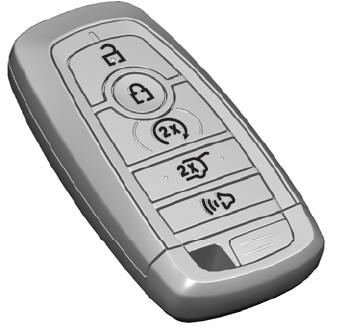
The passive key operates the power locks and the remote start system. The passive key must be in your vehicle to use the push button start.
Note: You may not be able to shift out of park (P) unless the passive key is inside your vehicle.
