Lincoln Aviator: Brakes / Hill Start Assist
WARNING: The system does not replace the parking brake. When you leave your vehicle, always apply the parking brake.
WARNING: You must remain in your vehicle when the system turns on. At all times, you are responsible for controlling your vehicle, supervising the system and intervening, if required. Failure to take care may result in the loss of control of your vehicle, serious personal injury or death.
WARNING: The system will turn off if a malfunction is apparent or if you rev the engine excessively. Failure to take care may result in the loss of control of your vehicle, serious personal injury or death.
The system makes it easier to pull away when your vehicle is on a slope without the need to use the parking brake.
When the system is active, your vehicle remains stationary on the slope for two to three seconds after you release the brake pedal. This allows time to move your foot from the brake to the accelerator pedal. The system releases the brakes automatically once the engine has developed sufficient torque to prevent your vehicle from rolling down the slope. This is an advantage when pulling away on a slope, for example from a car park ramp, traffic lights or when reversing uphill into a parking space.
The system activates on any slope that causes your vehicle to roll.
Note: There is no warning light to indicate the system is either on or off.
Using Hill Start Assist
- Press the brake pedal to bring your vehicle to a complete standstill. Keep the brake pedal pressed and shift into first gear when facing uphill or reverse (R) when facing downhill.
- If the sensors detect that your vehicle is on a slope, the system activates automatically.
- When you remove your foot from the brake pedal, your vehicle remains on the slope without rolling away for about two to three seconds. This hold time automatically extends if you are in the process of driving off.
- Drive off in the normal manner. The system releases the brakes automatically.
Note: When you remove your foot from the brake pedal and press the pedal again when the system is active, you will experience significantly reduced brake pedal travel. This is normal.
Switching the System On and Off
Vehicles with Manual Transmission
You can switch this feature on or off in the information display. The system remembers the last setting when you start your vehicle.
Vehicles with Automatic Transmission
You cannot turn the system on or off. When you switch the ignition on, the system automatically turns on.
 Electric Parking Brake
WARNING: Always fully apply the
parking brake and make sure you shift into
park (P). Failure to follow this instruction
could result in personal injury or death...
 Auto Hold
WARNING: The system does not
replace the parking brake. When you leave
your vehicle, always apply the parking
brake.
WARNING: You must remain in your
vehicle when the system turns on...
Other information:
Lincoln Aviator 2020-2026 Service Manual: Diagnosis and Testing - Fuel Charging
Diagnostic Trouble Code (DTC) Chart Diagnostics in this manual assume a certain skill level and knowledge of Ford-specific diagnostic practices.REFER to: Diagnostic Methods (100-00 General Information, Description and Operation). Diagnostic Trouble Code Chart Module DTC Description Action PCM P0201:00 Cylinder 1 Injector A Circuit/Open: No Sub Type Information GO to Pinpoint Test DI PCM P0202:00 Cylinder 2 Injector A Circuit/Open: No Sub Type Information GO to Pinpoint Test DI PCM P0203:00 Cylinder 3 Injector A Circuit/Open: No Sub Type Information GO to Pinpoint Test DI PCM P0204:00 Cylinder 4 Injector A Circuit/Open: No Sub Type Information GO to Pinpoint Test DI PCM P0205:00 Cylinder 5 Injector A Circuit/Open: No Sub Type Information GO to Pinpoint Test DI PCM P0206:00 Cylinder 6 Injector A Circuit/Open: No Sub Type Information GO to Pinpoint Test DI PCM P0207:00 Cylinder 7 Injector A Circuit/Open: No Sub Type Information GO to Pinpoint Test DI PCM P0208:00 Cylinder 8 Injector A Circuit/Open: No Sub Type Information GO to Pinpoint Test DI PCM P02EE:00 Cylinder 1 Injector Circuit Range/Performance: No Sub Type Information GO to Pinpoint Test DI PCM P02EF:00 Cylinder 2 Injector Circuit Range/Performance: No Sub Type Information GO to Pinpoint Test DI PCM P02F0:00 Cylinder 3 Injector Circuit Range/Performance: No Sub Type Information GO to Pinpoint Test DI PCM P02F1:00 Cylinder 4 Injector Circuit Range/Performance: No Sub Type Information GO to Pinpoint Test DI PCM P02F2:00 Cylinder 5 Injector Circuit Range/Performance: No Sub Type Information GO to Pinpoint Test DI PCM P02F3:00 Cylinder 6 Injector Circuit Range/Performance: No Sub Type Information GO to Pinpoint Test DI PCM P02F4:00 Cylinder 7 Injector Circuit Range/Performance: No Sub Type Information GO to Pinpoint Test DI PCM P02F5:00 Cylinder 8 Injector Circuit Range/Performance: No Sub Type Information GO to Pinpoint Test DI Global Customer Symptom Code (GCSC) Chart Diagnostics in this manual assume a certain skill level and knowledge of Ford-specific diagnostic practices...
Lincoln Aviator 2020-2026 Service Manual: Removal and Installation - Telematics Control Unit (TCU) Module
Removal NOTE: Removal steps in this procedure may contain installation details. NOTE: If installing a new module, it is necessary to upload the module configuration information to the scan tool prior to removing the module. This information must be downloaded into the new module after installation...
Categories
- Manuals Home
- Lincoln Aviator Owners Manual
- Lincoln Aviator Service Manual
- Changing the Front Wiper Blades - Vehicles With: Heated Wiper Blades
- Opening and Closing the Hood
- Garage Door Opener
- New on site
- Most important about car
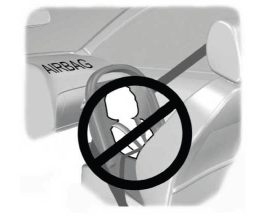
Children and Airbags
WARNING: Airbags can kill or injure a child in a child restraint. Never place a rear-facing child restraint in front of an active airbag. If you must use a forward-facing child restraint in the front seat, move the seat upon which the child restraint is installed all the way back.