
Lincoln Aviator 2020-2026 Service Manual / Chassis / Driveline / Driveshaft / Removal and Installation - Front Driveshaft Slip Yoke Boot
Lincoln Aviator: Driveshaft / Removal and Installation - Front Driveshaft Slip Yoke Boot
Special Tool(s) / General Equipment
| Crimping Tool |
Removal
-
Remove the transfer case.
-
-
Remove and discard the boot clamp.
-
Remove and discard the front driveshaft boot.
-
Remove and discard the boot clamp.
.jpg) |
Installation
-
NOTE: Make sure that the mating faces are clean and free of foreign material.
Clean the driveshaft splines and the boot mating surface.
.jpg) |
-
NOTE: Make sure that new components are installed.
Install a new clamp on to new boot.
.jpg) |
-
-
Push on new boot and clamp onto the spline stud yoke shaft.
-
Ensure that push the boot until the clamp reaches the boot groove.
-
Push on new boot and clamp onto the spline stud yoke shaft.
.jpg) |
-
Secure the clamp with crimping tool.
Use the General Equipment: Crimping Tool
.jpg) |
-
Install the transfer case.
 Removal and Installation - Front Driveshaft
Special Tool(s) /
General Equipment
Strap Wrench
Transmission Jack
Materials
Name
Specification
Motorcraft® High Temperature 4x4 Front Axle and Wheel Bearing GreaseXG-11
WSS-M1C267-A1
Slip Yoke Grease5L3Z-19A506-A
-
Removal
All vehicles
Disconnect battery terminals...
 Removal and Installation - Rear Driveshaft
Special Tool(s) /
General Equipment
100-001
(T50T-100-A)
Slide Hammer
205-832Remover, HalfshaftTKIT-2006C-FFMFLMTKIT-2006C-LMTKIT-2006C-ROW
Slide Hammer
Materials
Name
Specification
Motorcraft® Premium Long-Life GreaseXG-1-E1
ESA-M1C75-B
Removal
NOTE:
The maximum articulation of the flex coupling is 4 degrees...
Other information:
Lincoln Aviator 2020-2026 Service Manual: Description and Operation - Direct Current/Direct Current (DC/DC) Converter Control Module - System Operation and Component Description
System Operation System Diagram - DCDC Item Description 1 Ignition Switch 2 PCM 3 SOBDMC 4 BCM 5 BECM 6 DCDC 7 High Voltage/Low Current Fuse 8 12V Battery Monitoring Sensor Network Message Chart DCDC Network Input Messages Broadcast Message Originating Module Message Purpose DCDC HEV wake up enable BECM, BCCM (battery charger control module) ( PHEV only) Command to enable the DCDC DCDC HEV wake up enable SOBDMC Hard wired command to enable the DCDC High voltage input SOBDMC Voltage measured at SOBDMC used to compare with voltage at the DCDC...
Lincoln Aviator 2020-2026 Service Manual: Removal and Installation - Clockspring
Removal WARNING: The following procedure prescribes critical repair steps required for correct restraint system operation during a crash. Follow all notes and steps carefully. Failure to follow step instructions may result in incorrect operation of the restraint system and increases the risk of serious personal injury or death in a crash...
Categories
- Manuals Home
- Lincoln Aviator Owners Manual
- Lincoln Aviator Service Manual
- Body and Paint
- Disabling Auto-Start-Stop
- Remove and Reinstall the Battery
- New on site
- Most important about car
Child Seats
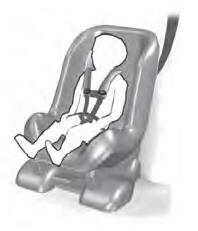
Use a child restraint (sometimes called an infant carrier, convertible seat, or toddler seat) for infants, toddlers and children weighing 40 lb (18 kg) or less (generally four-years-old or younger).
Using Lap and Shoulder Belts
WARNING: Do not place a rearward facing child restraint in front of an active airbag. Failure to follow this instruction could result in personal injury or death.

Copyright © 2026 www.liaviator2.com