Lincoln Aviator: Front Seats / Removal and Installation - Front Seat Backrest
Removal
.jpg) WARNING:
The following procedure describes critical repair steps
required for correct seat component installation. Follow all notes and
steps carefully. Do not place any objects between the seat components
and the body of the vehicle, nor any objects within a joint internal to
the seat structure. Failure to follow step instructions may result in
incorrect operation of the seat components and increases the risk of
serious personal injury.
WARNING:
The following procedure describes critical repair steps
required for correct seat component installation. Follow all notes and
steps carefully. Do not place any objects between the seat components
and the body of the vehicle, nor any objects within a joint internal to
the seat structure. Failure to follow step instructions may result in
incorrect operation of the seat components and increases the risk of
serious personal injury.
NOTE: Removal steps in this procedure may contain installation details.
NOTE: Driver seat with power head restraint shown, other seats similar.
-
Remove the front seat.
Refer to: Front Seat (501-10A Front Seats, Removal and Installation).
-
Remove the side shield screws.
.jpg) |
-
Remove the LH side shield.
-
Lift up and out, separating the side shield from the recliner bracket.
-
Slide the side shield forward and separate the side shield from the seat.
-
Lift up and out, separating the side shield from the recliner bracket.
.jpg) |
-
Remove the RH side shield.
-
Lift up and out, separating the side shield from the recliner bracket.
-
Slide the side shield forward and separate the side shield from the seat.
-
Lift up and out, separating the side shield from the recliner bracket.
.jpg) |
-
Remove the front seat backrest panel.
Refer to: Front Seat Backrest Panel (501-10A Front Seats, Removal and Installation).
-
NOTE: After disconnecting the hose and lock assembly, verify the black O-ring and white spacer remains with each hose.
NOTE: When connecting the hose and lock assemblies, an audible click must be heard for correct installation.
If equipped with multi-contour seats.
Detach the front seat cushion adjuster hose assembly.
-
Release the locking tab and disconnect the front seat cushion adjuster hose assembly from the SCMG.
-
Detach the retainers and position the front seat cushion adjuster hose assembly aside.
-
Release the locking tab and disconnect the front seat cushion adjuster hose assembly from the SCMG.
.jpg) |
-
NOTE: After disconnecting the hose and lock assemblies, verify the black O-ring and white spacer remains with each hose.
NOTE: When connecting the hose and lock assemblies, an audible click must be heard for correct installation.
If equipped with multi-contour seats.
Detach the multi-contour seat cushion hose retainers, release the locking tab, disconnect the hose and lock assembly from the SCMG and route the hose assembly out from the backrest.
.jpg) |
-
Remove the screws and the LH inner shield.
.jpg) |
-
Remove the screws and the RH inner shield.
.jpg) |
-
-
Disconnect the side airbag electrical connector.
-
Disconnect the front seat electrical connectors.
-
Detach the front seat wiring harness retainers.
-
Disconnect the side airbag electrical connector.
.jpg) |
-
On both sides.
Remove the bolts and the front seat backrest.
Torque: 35 lb.ft (47 Nm)
.jpg) |
-
NOTE: This step is only necessary when installing a new component.
Remove the side airbag.
Refer to: Side Airbag (501-20B Supplemental Restraint System, Removal and Installation).
-
NOTE: This step is only necessary when installing a new component.
Remove the front seat backrest cover.
Refer to: Front Seat Backrest Cover - Vehicles Without: Multi-Contour Seats (501-10A Front Seats, Removal and Installation).
Refer to: Front Seat Backrest Cover - Vehicles With: Multi-Contour Seats (501-10A Front Seats, Removal and Installation).
-
NOTE: This step is only necessary when installing a new component.
Remove the front seat power lumbar assembly.
Refer to: Front Seat Power Lumbar Assembly - Vehicles Without: Multi-Contour Seats (501-10A Front Seats, Removal and Installation).
Refer to: Front Seat Power Lumbar Assembly - Vehicles With: Multi-Contour Seats (501-10A Front Seats, Removal and Installation).
-
NOTE: This step is only necessary when installing a new component.
Remove the front head restraint guide sleeves.
Refer to: Front Head Restraint Guide Sleeve (501-10A Front Seats, Removal and Installation).
-
-
Feed the side airbag electrical connector through the front seat backrest frame.
-
Detach the side airbag wiring harness retainer.
-
Feed the side airbag electrical connector through the front seat backrest frame.
.jpg) |
-
NOTE: This step is only necessary when installing a new component.
Disconnect the front seat backrest electrical connectors and position aside.
.jpg) |
-
NOTE: This step is only necessary when installing a new component.
Remove the front seat backrest wiring harness.
-
Detach the wiring harness retainer.
-
Remove the screws.
-
Remove the pin-type retainers.
-
Detach the wiring harness retainer.
.jpg) |
-
NOTE: This step is only necessary when installing a new component.
Remove the screws.
.jpg) |
-
NOTE: This step is only necessary when installing a new component.
Remove the front seat backrest module bolts.
-
Remove the bolt.
Torque: 89 lb.in (10 Nm)
-
Remove the bolts.
Torque: 89 lb.in (10 Nm)
-
Remove the bolt.
.jpg) |
-
NOTE: This step is only necessary when installing a new component.
Remove the front seat backrest module.
.jpg) |
Installation
-
To install, reverse the removal procedure.
 Removal and Installation - Front Seat
Removal
WARNING:
The following procedure describes critical repair steps
required for correct seat component installation. Follow all notes and
steps carefully...
 Removal and Installation - Front Seat Backrest Blower Motor
Removal
NOTE:
Driver seat shown, passenger seat similar.
Remove the front seat.
Refer to: Front Seat (501-10A Front Seats, Removal and Installation)...
Other information:
Lincoln Aviator 2020-2026 Service Manual: Diagnosis and Testing - Reversing Lamps
Diagnostic Trouble Code (DTC) Chart Diagnostics in this manual assume a certain skill level and knowledge of Ford-specific diagnostic practices. REFER to: Diagnostic Methods (100-00 General Information, Description and Operation). Diagnostic Trouble Code Chart Module DTC Description Action BCM B1277:11 Reverse Lamp: Circuit Short To Ground GO to Pinpoint Test A BCM B1277:15 Reverse Lamp: Circuit Short To Battery or Open GO to Pinpoint Test A Symptom Charts Diagnostics in this manual assume a certain skill level and knowledge of Ford-specific diagnostic practices...
Lincoln Aviator 2020-2026 Service Manual: General Procedures - Inspection and Repair after a Supplemental Restraint System (SRS) Deployment
Inspection NOTE: Deployable devices such as airbags, pretensioners and inflatable belt inflators, may deploy alone or in various combinations depending on the impact event. NOTE: Always refer to the appropriate workshop manual procedures prior to carrying out vehicle repairs affecting the SRS and seatbelt system...
Categories
- Manuals Home
- Lincoln Aviator Owners Manual
- Lincoln Aviator Service Manual
- Configuring The Head Up Display
- USB Port and Power Point Locations
- Wireless Accessory Charger (If Equipped)
- New on site
- Most important about car
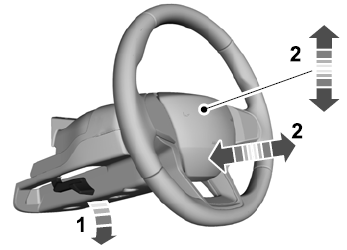
Adjusting the Steering Wheel - Vehicles With: Manual Adjustable Steering Column
WARNING: Do not adjust the steering wheel when your vehicle is moving.
Note: Make sure that you are sitting in the correct position.
Unlock the steering column. Adjust the steering wheel to the desired position.