Lincoln Aviator: Front Suspension - AWD / Removal and Installation - Front Stabilizer Bar Link
Removal
NOTICE: Suspension fasteners are critical parts that affect the performance of vital components and systems. Failure of these fasteners may result in major service expense. Use the same or equivalent parts if replacement is necessary. Do not use a replacement part of lesser quality or substitute design. Tighten fasteners as specified.
NOTE: Removal steps in this procedure may contain installation details.
-
Remove the wheel and tire.
Refer to: Wheel and Tire (204-04A Wheels and Tires, Removal and Installation).
-
NOTICE: Do not use power tools to remove the stabilizer bar link nut. Damage to the stabilizer bar link ball joint or boot may occur.
NOTE: The stabilizer bar links are designed with low friction ball joints that have a low breakaway torque.
NOTE: Use the TORX PLUS® holding feature to prevent the ball stud from turning while removing or installing the stabilizer bar link nut. Torx® and TORX PLUS® is a reg. tm of Acument Intellectual Properties, LLC.
-
Remove and discard the front stabilizer bar link lower nut.
Torque: 129 lb.ft (175 Nm)
-
Position aside the front stabilizer bar link.
-
Remove and discard the front stabilizer bar link lower nut.
.jpg) |
-
NOTICE: Do not use power tools to remove the stabilizer bar link nut. Damage to the stabilizer bar link ball joint or boot may occur.
NOTE: The stabilizer bar links are designed with low friction ball joints that have a low breakaway torque.
NOTE: Use the TORX PLUS® holding feature to prevent the ball stud from turning while removing or installing the stabilizer bar link nut. Torx® and TORX PLUS® is a reg. tm of Acument Intellectual Properties, LLC.
-
Remove and discard the front stabilizer bar link upper nut.
Torque: 129 lb.ft (175 Nm)
-
Remove the front stabilizer bar link.
-
Remove and discard the front stabilizer bar link upper nut.
.jpg) |
Installation
-
To install, reverse the removal procedure.
 Removal and Installation - Front Stabilizer Bar
Removal
NOTICE:
Suspension fasteners are critical parts that affect the
performance of vital components and systems. Failure of these fasteners
may result in major service expense...
 Removal and Installation - Front Wheel Bearing and Wheel Hub
Special Tool(s) /
General Equipment
204-161
(T97P-1175-A)
Installer, HalfshaftTKIT-1997-LM2TKIT-1997-F/FM2TKIT-1997-FLM2
205-D070
(D93P-1175-B)
Remover, Front Wheel Hub
Removal
NOTICE:
Suspension fasteners are critical parts that affect
performance of vital components and systems...
Other information:
Lincoln Aviator 2020-2026 Service Manual: Removal and Installation - AM/FM1 Antenna Amplifier
Removal NOTE: Removal steps in this procedure may contain installation details. Remove the RH upper D-pillar trim panel. Refer to: D-Pillar Trim Panel (501-05 Interior Trim and Ornamentation, Removal and Installation). Disconnect the connectors, remove the screw and the AM/FM1 antenna amplifier...
Lincoln Aviator 2020-2026 Service Manual: Removal and Installation - Hands-Free Liftgate Actuation Module
Removal NOTE: Removal steps in this procedure may contain installation details. Remove the rear bumper cover. Refer to: Rear Bumper Cover (501-19 Bumpers, Removal and Installation). Disconnect the hands-free liftgate actuation module electrical connectors...
Categories
- Manuals Home
- Lincoln Aviator Owners Manual
- Lincoln Aviator Service Manual
- Fuel Quality
- Disabling Auto-Start-Stop
- General Procedures - Transmission Fluid Drain and Refill
- New on site
- Most important about car
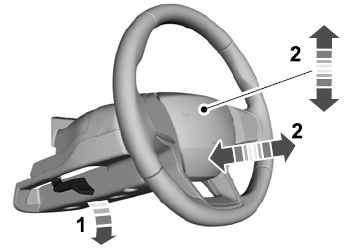
Adjusting the Steering Wheel - Vehicles With: Manual Adjustable Steering Column
WARNING: Do not adjust the steering wheel when your vehicle is moving.
Note: Make sure that you are sitting in the correct position.
Unlock the steering column. Adjust the steering wheel to the desired position.