
Lincoln Aviator 2020-2026 Service Manual / Powertrain / Automatic Transmission / Automatic Transmission - 10-Speed Automatic Transmission – 10R60 / Removal and Installation - Output Shaft Speed (OSS) Sensor
Lincoln Aviator: Automatic Transmission - 10-Speed Automatic Transmission – 10R60 / Removal and Installation - Output Shaft Speed (OSS) Sensor
Removal
-
Remove the main control valve body.
Refer to: Main Control Valve Body (307-01A Automatic Transmission - 10-Speed Automatic Transmission – 10R60, Removal and Installation).
-
Remove the OSS sensor.
-
Slide the plastic lock to the unlocked position.
While pressing the plastic tab, disconnect the electrical connector.
-
Remove the bolt and the OSS sensor.
-
Slide the plastic lock to the unlocked position.
While pressing the plastic tab, disconnect the electrical connector.
.jpg) |
Installation
-
Install the OSS sensor.
-
Install the OSS sensor bolt.
Torque: 62 lb.in (7 Nm)
-
Connect the electrical connector. Slide the plastic lock to the locked position.
-
Install the OSS sensor bolt.
.jpg) |
-
Install the main control valve body.
Refer to: Main Control Valve Body (307-01A Automatic Transmission - 10-Speed Automatic Transmission – 10R60, Removal and Installation).
 Removal and Installation - Output Shaft Seal
Special Tool(s) /
General Equipment
100-001
(T50T-100-A)
Slide Hammer
205-1018Installation Tube
307-309Remover, Torque Converter SealTKIT-1994-FMH/FLMHTKIT-1994-LMH/MHTKIT-1994-FH
307-782Installer, Output Shaft Seal
Punch
Removal
With the vehicle in NEUTRAL, position it on a hoist...
 Removal and Installation - Park Lock Pawl Solenoid
Removal
Remove the transmission fluid pan, gasket and filter.
Refer to: Transmission Fluid Pan, Gasket and Filter (307-01B Automatic Transmission - 10-Speed Automatic Transmission – 10R80 MHT, Removal and Installation)...
Other information:
Lincoln Aviator 2020-2026 Service Manual: Diagnosis and Testing - Front Drive Axle
Principles of Operation Inspection and Verification Verify the customer concern. Visually inspect for obvious signs of mechanical or electrical damage. If an obvious cause for an observed or reported concern is found, correct the cause (if possible) before proceeding to the next step...
Lincoln Aviator 2020-2026 Service Manual: Description and Operation - Body Closures - Overview
Overview The power liftgate feature allows power opening and closing of the liftgate using any of the following methods: The front power liftgate switch (located on the instrument panel). The rear interior power liftgate switch (located on the bottom of the liftgate trim panel) (close only)...
Categories
- Manuals Home
- Lincoln Aviator Owners Manual
- Lincoln Aviator Service Manual
- Tire Change Procedure
- USB Port and Power Point Locations
- Disabling Auto-Start-Stop
- New on site
- Most important about car
Remote Control
Passive Key
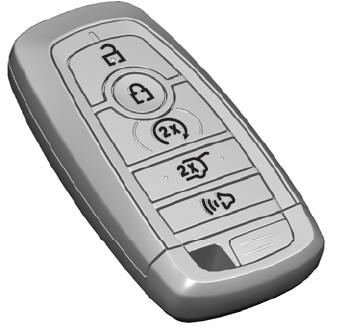
The passive key operates the power locks and the remote start system. The passive key must be in your vehicle to use the push button start.
Note: You may not be able to shift out of park (P) unless the passive key is inside your vehicle.

Copyright © 2026 www.liaviator2.com