Lincoln Aviator: Installing Child Restraints / Using Tether Straps
 Many forward-facing child
restraints include a tether strap
which extends from the back of the
child restraint and hooks to an anchoring
point called the top tether anchor. Tether
straps are available as an accessory for many
older child restraints.
Contact the manufacturer of your child restraint for information about ordering a tether strap, or to obtain a longer tether strap if the tether strap on your child restraint does not reach the appropriate top tether anchor in your vehicle.
Once you install the child restraint using either the seatbelt, the lower anchors of the LATCH system, or both, you can attach the top tether strap.
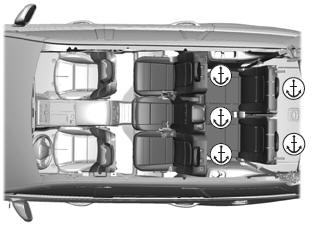
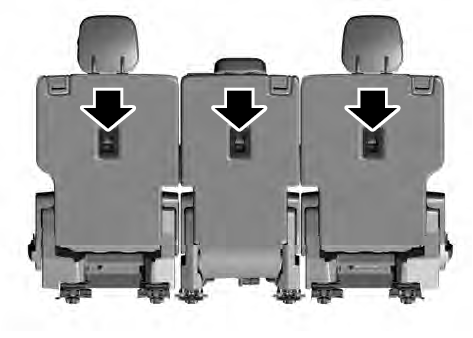
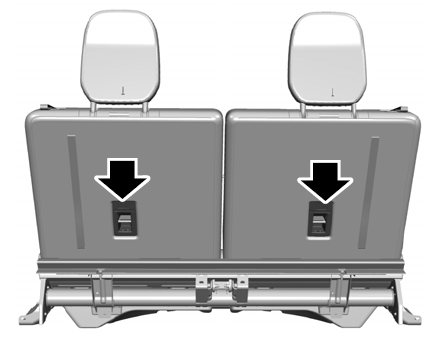
The tether strap anchors in your vehicle are in the following positions (shown from top view):
Second Row Bucket Seats and Third Row Seats
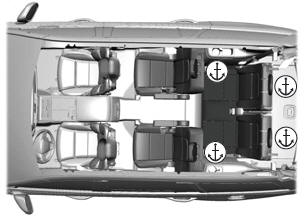
Second Row Bench Seats and Third Row Seats
Perform the following steps to install a child restraint with tether anchors:
Note: If you install a child restraint with rigid LATCH attachments, do not tighten the tether strap enough to lift the child restraint off your vehicle seat cushion when the child is seated in it. Keep the tether strap just snug without lifting the front of the child restraint. Keeping the child restraint just touching your vehicle seat gives the best protection in a severe crash.
For second row outermost seating positions, route the child restraint tether strap over the seat backrest, under the head restraint and between the head restraint posts. If needed, remove the head restraint to improve the fit of the child restraint or tether strap.
For the second row center seating position, route the child restraint tether strap over the top of the head restraint. If needed, remove the head restraint to improve the fit of the child restraint or tether strap.
For third row seating positions, route the child restraint tether strap over the seat backrest, under the head restraint and between the head restraint posts. If needed, fold the head restraint down to improve the fit of the child restraint or tether strap.
- Route the tether strap.
- Locate the correct anchor for the selected seating position.
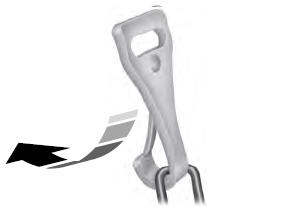
- Clip the tether strap to the anchor as
shown. The tether hook may be twisted
½ turn to improve installation. If you clip
the tether strap incorrectly, the child
restraint may not be retained properly in
the event of a crash.
- Tighten the child restraint tether strap according to the manufacturer's instructions.
If the child restraint is not anchored properly, the risk of injury to a child greatly increases in a crash.
If your child restraint system has a tether strap, and the child restraint manufacturer recommends its use, we also recommend its use.
Second Row Bench Seats
Third Row Seats
Note: The cargo tie downs at the rear edge of the floor are not tether anchors.
 Using Lower Anchors and Tethers for CHildren (LATCH)
WARNING: Do not attach two child
safety restraints to the same anchor. In a
crash, one anchor may not be strong
enough to hold two child safety restraint
attachments and may break, causing
serious injury or death...
 Booster Seats
WARNING: Do not put the shoulder
section of the seatbelt or allow the child to
put the shoulder section of the seatbelt
under their arm or behind their back...
Other information:
Lincoln Aviator 2020-2026 Service Manual: Diagnosis and Testing - Battery
General Equipment Diagnostic Battery Charger Use Ford approved battery test equipment. Midtronics MDX-650 or P-300/P-600/490/1050 Midtronics GRX-3590 or 3000 Diagnostics in this manual assume a certain skill level and knowledge of Ford-specific diagnostic practices...
Lincoln Aviator 2020-2026 Service Manual: Diagnosis and Testing - Evaporative Emissions
Diagnostic Trouble Code (DTC) Chart Diagnostics in this manual assume a certain skill level and knowledge of Ford-specific diagnostic practices.REFER to: Diagnostic Methods (100-00 General Information, Description and Operation). Diagnostic Trouble Code Chart Module DTC Description Action PCM P00FE:00 EVAP System Tank Vapor Line Restricted/Blocked: No Sub Type Information GO to Pinpoint Test HX PCM P043E:00 EVAP System Leak Detection Reference Orifice Low Flow: No Sub Type Information GO to Pinpoint Test HX PCM P043F:00 EVAP System Leak Detection Reference Orifice High Flow: No Sub Type Information GO to Pinpoint Test HX PCM P0442:00 EVAP System Leak Detected (Small Leak): No Sub Type Information GO to Pinpoint Test HX PCM P0443:00 EVAP System Purge Control Valve A Circuit: No Sub Type Information GO to Pinpoint Test HX PCM P0446:00 EVAP System Vent Control Circuit: No Sub Type Information GO to Pinpoint Test HX PCM P0451:00 EVAP System Pressure Sensor / Switch A Circuit Range / Performance: No Sub Type Information GO to Pinpoint Test HX PCM P0452:00 EVAP System Pressure Sensor / Switch A Circuit Low: No Sub Type Information GO to Pinpoint Test HX PCM P0453:00 EVAP System Pressure Sensor / Switch A Circuit High: No Sub Type Information GO to Pinpoint Test HX PCM P0454:00 EVAP System Pressure Sensor / Switch A Circuit Intermittent: No Sub Type Information GO to Pinpoint Test HX PCM P0455:00 EVAP System Leak Detected (Large Leak): No Sub Type Information GO to Pinpoint Test HX PCM P0456:00 EVAP System Leak Detected (Very Small Leak): No Sub Type Information GO to Pinpoint Test HX PCM P0457:00 EVAP System Leak Detected (Fuel Cap Loose / Off): No Sub Type Information GO to Pinpoint Test HX PCM P0460:00 Fuel Level Sensor A Circuit: No Sub Type Information GO to Pinpoint Test HX PCM P0461:00 Fuel Level Sensor A Circuit Range/Performance: No Sub Type Information GO to Pinpoint Test HX PCM P0462:00 Fuel Level Sensor A Circuit Low: No Sub Type Information GO to Pinpoint Test HX PCM P0463:00 Fuel Level Sensor A Circuit High: No Sub Type Information GO to Pinpoint Test HX PCM P0496:00 EVAP System High Purge Flow: No Sub Type Information GO to Pinpoint Test HX PCM P04EA:00 EVAP System Small Leak Detected - Fuel Tank Side: No Sub Type Information GO to Pinpoint Test HX PCM P04EB:00 EVAP System Small Leak Detected - Fresh Air Side: No Sub Type Information GO to Pinpoint Test HX PCM P04ED:00 EVAP System Large Leak Detected - Fresh Air Side: No Sub Type Information GO to Pinpoint Test HX PCM P04EE:00 EVAP System Very Small Leak Detected - Fuel Tank Side: No Sub Type Information GO to Pinpoint Test HX PCM P04EF:00 EVAP System Very Small Leak Detected - Fresh Air Side: No Sub Type Information GO to Pinpoint Test HX PCM P04F0:00 EVAP System High Load Purge Line A Performance: No Sub Type Information GO to Pinpoint Test HX PCM P144A:00 EVAP System Purge Vapor Line Restricted/Blocked: No Sub Type Information GO to Pinpoint Test HX PCM P144B:00 EVAP System Secondary Purge Vapor Line Restricted/Blocked: No Sub Type Information GO to Pinpoint Test HX PCM P144C:00 EVAP System Purge Flow Performance During Boost: No Sub Type Information GO to Pinpoint Test HX PCM P1450:00 Unable To Bleed Up Fuel Tank Vacuum: No Sub Type Information GO to Pinpoint Test HX PCM P2401:00 EVAP System Leak Detection Pump Control Circuit Low: No Sub Type Information GO to Pinpoint Test HX PCM P2402:00 EVAP System Leak Detection Pump Control Circuit High: No Sub Type Information GO to Pinpoint Test HX PCM P2418:00 EVAP System Switching Valve Control Circuit/Open: No Sub Type Information GO to Pinpoint Test HX PCM P2450:00 EVAP System Switching Valve Performance/Stuck Open: No Sub Type Information GO to Pinpoint Test HX PCM P2451:00 EVAP System Switching Valve Stuck Closed: No Sub Type Information GO to Pinpoint Test HX PCM P24B9:00 EVAP System Leak Detection Pump Pressure Sensor Circuit Range/Performance: No Sub Type Information GO to Pinpoint Test HX PCM P24BA:00 EVAP System Leak Detection Pump Pressure Sensor Circuit Low: No Sub Type Information GO to Pinpoint Test HX PCM P24BB:00 EVAP System Leak Detection Pump Pressure Sensor Circuit High: No Sub Type Information GO to Pinpoint Test HX PCM P24BC:00 EVAP System Leak Detection Pump Pressure Sensor Circuit Intermittent: No Sub Type Information GO to Pinpoint Test HX PCM P24BE:00 EVAP System Leak Detection Pump Vacuum Switching Valve Control Circuit Low: No Sub Type Information GO to Pinpoint Test HX PCM P24BF:00 EVAP System Leak Detection Pump Vacuum Switching Valve Control Circuit High: No Sub Type Information GO to Pinpoint Test HX PCM P24C0:00 EVAP System Leak Detection Pump Vacuum Switching Valve Stuck On: No Sub Type Information GO to Pinpoint Test HX PCM P24C1:00 EVAP System Leak Detection Pump Vacuum Switching Valve Performance/Stuck Off: No Sub Type Information GO to Pinpoint Test HX PCM P260F:00 EVAP System Monitoring Processor Performance: No Sub Type Information GO to Pinpoint Test HX PCM P2DDA:00 EVAP System Leak Detection Pump Performance/Stuck Off: No Sub Type Information GO to Pinpoint Test HX PCM P2DDB:00 EVAP System Leak Detection Pump Stuck On: No Sub Type Information GO to Pinpoint Test HX Global Customer Symptom Code (GCSC) Chart Diagnostics in this manual assume a certain skill level and knowledge of Ford-specific diagnostic practices...
Categories
- Manuals Home
- Lincoln Aviator Owners Manual
- Lincoln Aviator Service Manual
- Wireless Accessory Charger (If Equipped)
- Resetting the System
- Keyless Entry
- New on site
- Most important about car
Activating Intelligent Access
The intelligent access key must be within 3 ft (1 m) of the door or luggage compartment you intend to lock or unlock.
At a Door
Electronic door handles are on each door. Gently depress the switch inside the exterior door handle to unlock and open the door. An unlock symbol illuminates on the door window trim indicating your vehicle is unlocked.