
Lincoln Aviator: Body Repairs - General Information / General Procedures - Welding Precautions
Check
.jpg) WARNING:
Invisible ultraviolet and infrared rays emitted in welding
can injure unprotected eyes and skin. Always use protection such as a
welder's helmet with dark-colored filter lenses of the correct density.
Electric welding will produce intense radiation, therefore, filter plate
lenses of the deepest shade providing adequate visibility are
recommended. It is strongly recommended that persons working in the weld
area wear flash safety goggles. Also wear protective clothing. Failure
to follow these instructions may result in serious personal injury.
WARNING:
Invisible ultraviolet and infrared rays emitted in welding
can injure unprotected eyes and skin. Always use protection such as a
welder's helmet with dark-colored filter lenses of the correct density.
Electric welding will produce intense radiation, therefore, filter plate
lenses of the deepest shade providing adequate visibility are
recommended. It is strongly recommended that persons working in the weld
area wear flash safety goggles. Also wear protective clothing. Failure
to follow these instructions may result in serious personal injury.
WARNING:
Always wear protective equipment including eye protection
with side shields, and a dust mask when sanding or grinding. Failure to
follow these instructions may result in serious personal injury.
NOTICE: SRS components should always be depowered and disconnected before beginning any welding procedure.
NOTICE: Electronic modules and related wiring can be damaged when exposed to heat from welding procedures. Carefully disconnect and remove, or position away from heat affected areas.
NOTICE: EV (Electric Vehicle), HEV and PHEVcontain a HVTB (High Voltage Traction Battery). Before welding near the HVTB, the HVTB must be removed to avoid heat damage.
-
A test weld should always be carried out on a test sample.
-
The correct protective clothing should always be worn.
-
Always work in a well ventilated area to avoid accumulation of noxious and oxygen displacing gases.
-
Place protective covers around components and wiring harnesses to protect from welding spatter.
-
Use grinding discs and wire brushes dedicated to the type of material being welded.
-
Follow equipment manufacturer's prescribed procedures
and equipment settings for the type of weld being used. ER70S-3 or
ER70S-6 wire is typically used for MIG welding on steel.
-
Disconnect and isolate battery ground cable.
-
Components made of Boron, Martensitic, HSS
(high-strength steel) and UHSS (ultra high-strength) steel should not be
heated to straighten or repair. Severely bent or kinked components
should be replaced with new ones.
-
Factory welds may be substituted with either STRW (squeeze-type resistance welding) spot welds or MIG plug welds.
-
MIG plug welds must equal factory welds in both location and quantity.
-
MIG plug weld holes should equal 8 mm (0.31 in) diameter.
-
Resistance spot welds must equal factory welds in quantity and be placed adjacent to original weld location.
-
Disconnect on-vehicle modules and protect them from possible heat damage and electrical currents when welding.
-
Use of a weld-through primer is recommended where applicable.
-
When welding, always place the ground clamp as close as possible to the weld area.
-
Never connect the welder ground clamp to the vehicle subframe.
-
Never weld a vehicle subframe, steering or suspension component. Service is through replacement only.
 General Procedures - Plastic Repairs
Materials
Name
Specification
Plastic Bonding AdhesiveTA-9
-
Inspection
NOTE:
Plastics Identification
WARNING:
Before beginning any service procedure in this
manual, refer to health and safety warnings in section 100-00 General
Information...

Other information:
Lincoln Aviator 2020-2026 Service Manual: Description and Operation - Third Row Seats - System Operation and Component Description
System Operation System Diagram Item Description 1 SCMJ 2 HS-CAN1 3 PCM 4 Liftgate Ajar Switch 5 Power Fold Seat Control Switch 6 Power Folding Seat Motors 7 Hall-Effect Sensors 8 Motors 9 MS-CAN 10 GWM 11 BCM Network Message Chart SCMJ Network Input Messages Broadcast Message Originating Module Message Purpose Vehicle speed PCM The vehicle speed is one of the inputs the SCMJ requires to enable the power folding seat feature...
Lincoln Aviator 2020-2026 Service Manual: Removal and Installation - Front Seat Cushion Extension Adjuster
Removal NOTE: Removal steps in this procedure may contain installation details. NOTE: Driver seat with power head restraint shown, other seats similar. Remove the front seat. Refer to: Front Seat (501-10A Front Seats, Removal and Installation)...
Categories
- Manuals Home
- Lincoln Aviator Owners Manual
- Lincoln Aviator Service Manual
- Locking and Unlocking
- Body and Paint
- Child Safety Locks
- New on site
- Most important about car
Child Seats
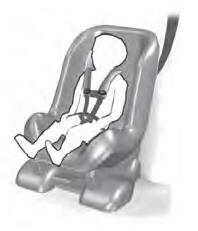
Use a child restraint (sometimes called an infant carrier, convertible seat, or toddler seat) for infants, toddlers and children weighing 40 lb (18 kg) or less (generally four-years-old or younger).
Using Lap and Shoulder Belts
WARNING: Do not place a rearward facing child restraint in front of an active airbag. Failure to follow this instruction could result in personal injury or death.
