
Lincoln Aviator: Battery and Charging System / High Voltage Battery Charging System

Removal and Installation - High Voltage Battery Cables - Plug-In Hybrid Electric Vehicle (PHEV)

Removal   WARNING: To prevent the risk of high-voltage shock, always follow precisely all warnings and service instructions, including instructions to depower the system...

Description and Operation - High Voltage Battery Charging System - Plug-In Hybrid Electric Vehicle (PHEV) - Component Location

..

Other information:

Lincoln Aviator 2020-2026 Service Manual: Description and Operation - Airbag and Seatbelt Pretensioner Supplemental Restraint System (SRS) - System Operation and Component Description


System Operation System Diagram - Supplemental Restraint System (SRS) Item Description 1 RCM 2 Ignition Switch 3 GWM 4 Driver Seatbelt Buckle Switch 5 Passenger Seatbelt Buckle Switch 6 RHFront Impact Severity Sensor 7 Driver Door Side Impact Sensor 8 Driver C-Pillar Side Impact Sensor 9 Passenger Belt Tension Sensor (BTS) 10 Passenger Seat Position Sensor 11 Driver Seat Position Sensor 12 APIM 13 Passenger Door Side Impact Sensor 14 BCM 15 Driver Second Row Seatbelt Buckle Switch 16 Passenger Second Row Seatbelt Buckle Switch 17 LH Front Impact Severity Sensor 18 OCSM 19 Center Second Row Seatbelt Buckle Switch 20 Passenger C-Pillar Side Impact Sensor 21 Driver Third Row Seatbelt Buckle Switch 22 Passenger Third Row Seatbelt Buckle Switch 23 IPC Item Description 1 Passenger Seatbelt Anchor Pretensioner 2 Driver Seatbelt Anchor Pretensioner 3 Driver Seatbelt Retractor Pretensioner 4 Passenger Side Curtain Airbag 5 Driver Side Curtain Airbag 6 Passenger Side Airbag 7 Driver Side Airbag 8 Passenger Airbag (Stages 1 and 2) 9 Driver Airbag (Stages 1 and 2) 10 RCM 11 BCM 12 Passenger Seatbelt Adaptive Load Limiter 13 Passenger Seatbelt Retractor Pretensioner 14 Passenger Load Limiting Retractor 15 Passenger Airbag Vent (if equipped) 16 Passenger Knee Airbag 17 Driver Knee Airbag 18 Driver Second Row Seatbelt Retractor 19 Passenger Second Row Seatbelt Retractor Network Message Chart - Supplemental Restraint System (SRS)   Module Network Input Messages - RCM Broadcast Message Originating Module Message Purpose eCall confirmation   APIM Used for SYNC® 911 Assist™ operation...

Lincoln Aviator 2020-2026 Service Manual: Diagnosis and Testing - Engine Ignition


Diagnostic Trouble Code (DTC) Chart Diagnostics in this manual assume a certain skill level and knowledge of Ford-specific diagnostic practices.REFER to: Diagnostic Methods (100-00 General Information, Description and Operation).   Diagnostic Trouble Code Chart Module   DTC Description Action   PCM P0300:00 Random Misfire Detected: No Sub Type Information   GO to Pinpoint Test HD   PCM P0301:00 Cylinder 1 Misfire Detected: No Sub Type Information   GO to Pinpoint Test HD   PCM P0302:00 Cylinder 2 Misfire Detected: No Sub Type Information   GO to Pinpoint Test HD   PCM P0303:00 Cylinder 3 Misfire Detected: No Sub Type Information   GO to Pinpoint Test HD   PCM P0304:00 Cylinder 4 Misfire Detected: No Sub Type Information   GO to Pinpoint Test HD   PCM P0305:00 Cylinder 5 Misfire Detected: No Sub Type Information   GO to Pinpoint Test HD   PCM P0306:00 Cylinder 6 Misfire Detected: No Sub Type Information   GO to Pinpoint Test HD   PCM P0307:00 Cylinder 7 Misfire Detected: No Sub Type Information   GO to Pinpoint Test HD   PCM P0308:00 Cylinder 8 Misfire Detected: No Sub Type Information   GO to Pinpoint Test HD   PCM P0313:00 Misfire Detected With Low Fuel: No Sub Type Information   GO to Pinpoint Test HD   PCM P0316:00 Misfire Detected On Startup (First 1000 Revolutions): No Sub Type Information   GO to Pinpoint Test HD   PCM P0325:00 Knock/Combustion Vibration Sensor A Circuit: No Sub Type Information   GO to Pinpoint Test DG   PCM P0327:00 Knock/Combustion Vibration Sensor A Circuit Low: No Sub Type Information   GO to Pinpoint Test DG   PCM P0328:00 Knock/Combustion Vibration Sensor A Circuit High: No Sub Type Information   GO to Pinpoint Test DG   PCM P032A:00 Knock/Combustion Vibration Sensor C Circuit: No Sub Type Information   GO to Pinpoint Test DG   PCM P032C:00 Knock/Combustion Vibration Sensor C Circuit Low: No Sub Type Information   GO to Pinpoint Test DG   PCM P032D:00 Knock/Combustion Vibration Sensor C Circuit High: No Sub Type Information   GO to Pinpoint Test DG   PCM P0330:00 Knock/Combustion Vibration Sensor B Circuit: No Sub Type Information   GO to Pinpoint Test DG   PCM P0332:00 Knock/Combustion Vibration Sensor B Circuit Low: No Sub Type Information   GO to Pinpoint Test DG   PCM P0333:00 Knock/Combustion Vibration Sensor B Circuit High: No Sub Type Information   GO to Pinpoint Test DG   PCM P033A:00 Knock/Combustion Vibration Sensor D Circuit: No Sub Type Information   GO to Pinpoint Test DG   PCM P033C:00 Knock/Combustion Vibration Sensor D Circuit Low: No Sub Type Information   GO to Pinpoint Test DG   PCM P033D:00 Knock/Combustion Vibration Sensor D Circuit High: No Sub Type Information   GO to Pinpoint Test DG   PCM P0351:00 Ignition Coil A Primary Control Circuit/Open: No Sub Type Information   GO to Pinpoint Test JF   PCM P0352:00 Ignition Coil B Primary Control Circuit/Open: No Sub Type Information   GO to Pinpoint Test JF   PCM P0353:00 Ignition Coil C Primary Control Circuit/Open: No Sub Type Information   GO to Pinpoint Test JF   PCM P0354:00 Ignition Coil D Primary Control Circuit/Open: No Sub Type Information   GO to Pinpoint Test JF   PCM P0355:00 Ignition Coil E Primary Control Circuit/Open: No Sub Type Information   GO to Pinpoint Test JF   PCM P0356:00 Ignition Coil F Primary Control Circuit/Open: No Sub Type Information   GO to Pinpoint Test JF   PCM P0357:00 Ignition Coil G Primary Control Circuit/Open: No Sub Type Information   GO to Pinpoint Test JF   PCM P0358:00 Ignition Coil H Primary Control Circuit/Open: No Sub Type Information   GO to Pinpoint Test JF   PCM P06B6:00 Internal Control Module Knock Sensor Processor 1 Performance: No Sub Type Information   GO to Pinpoint Test DG   PCM P06D1:00 Internal Control Module Ignition Coil Control Module Performance: No Sub Type Information   GO to Pinpoint Test JF   PCM P112A:00 Too Many Engine Starts During Factory/Transport Mode: No Sub Type Information   GO to Pinpoint Test JB   PCM P130D:00 Engine Knock/Combustion Performance - Forced Limited Power: No Sub Type Information   GO to Pinpoint Test DG   PCM P2300:00 Ignition Coil A Primary Control Circuit Low: No Sub Type Information   GO to Pinpoint Test JF   PCM P2301:00 Ignition Coil A Primary Control Circuit High: No Sub Type Information   GO to Pinpoint Test JF   PCM P2303:00 Ignition Coil B Primary Control Circuit Low: No Sub Type Information   GO to Pinpoint Test JF   PCM P2304:00 Ignition Coil B Primary Control Circuit High: No Sub Type Information   GO to Pinpoint Test JF   PCM P2306:00 Ignition Coil C Primary Control Circuit Low: No Sub Type Information   GO to Pinpoint Test JF   PCM P2307:00 Ignition Coil C Primary Control Circuit High: No Sub Type Information   GO to Pinpoint Test JF   PCM P2309:00 Ignition Coil D Primary Control Circuit Low: No Sub Type Information   GO to Pinpoint Test JF   PCM P2310:00 Ignition Coil D Primary Control Circuit High: No Sub Type Information   GO to Pinpoint Test JF   PCM P2312:00 Ignition Coil E Primary Control Circuit Low: No Sub Type Information   GO to Pinpoint Test JF   PCM P2313:00 Ignition Coil E Primary Control Circuit High: No Sub Type Information   GO to Pinpoint Test JF   PCM P2315:00 Ignition Coil F Primary Control Circuit Low: No Sub Type Information   GO to Pinpoint Test JF   PCM P2316:00 Ignition Coil F Primary Control Circuit High: No Sub Type Information   GO to Pinpoint Test JF   PCM P2319:00 Ignition Coil G Primary Control Circuit High: No Sub Type Information   GO to Pinpoint Test JF   PCM P2322:00 Ignition Coil H Primary Control Circuit High: No Sub Type Information   GO to Pinpoint Test JF Global Customer Symptom Code (GCSC) Chart Diagnostics in this manual assume a certain skill level and knowledge of Ford-specific diagnostic practices...

Categories

Activating Intelligent Access

The intelligent access key must be within 3 ft (1 m) of the door or luggage compartment you intend to lock or unlock.

At a Door

Electronic door handles are on each door. Gently depress the switch inside the exterior door handle to unlock and open the door. An unlock symbol illuminates on the door window trim indicating your vehicle is unlocked.
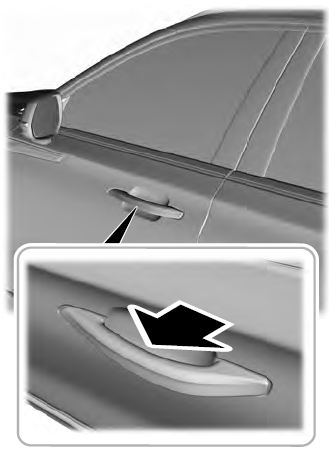
Lincoln Aviator. Activating Intelligent Access

read more

 
Copyright © 2026 www.liaviator2.com